

Today’s post starts with a simple question: Can wind turbines and solar panels be created from a supply chain powered by wind turbines and solar panels?
The answer is no.
Wind turbines and solar panels come from supply chains that are fossil fuel intensive and technological options to replace those fossil fuels in their production do not yet exist, and may never exist. This post unpacks the details.
To be absolutely clear, what follows is not an argument against wind and solar. THB readers will know that I am bullish on solar and not so much on wind. I’ve long argued that the lowest hanging fruit for large emissions reductions is dirty coal plants, which can be replaced with natural gas, nuclear, as well as wind and solar with storage.
Today’s post is an exercise in understanding quantitatively the true challenges of an energy transition and move beyond the claim that we have all the technology we need for deep decarbonization — typically emphasizing extensive deployment of wind and solar energy generation, accompanied by battery storage.
So-called “renewables” are not remotely renewable. To be sure, solar and wind technologies, coupled with storage, can contribute to the decarbonization of electricity. However, they are each built on a deep foundation of fossil fuels.1
Let’s look at some numbers.
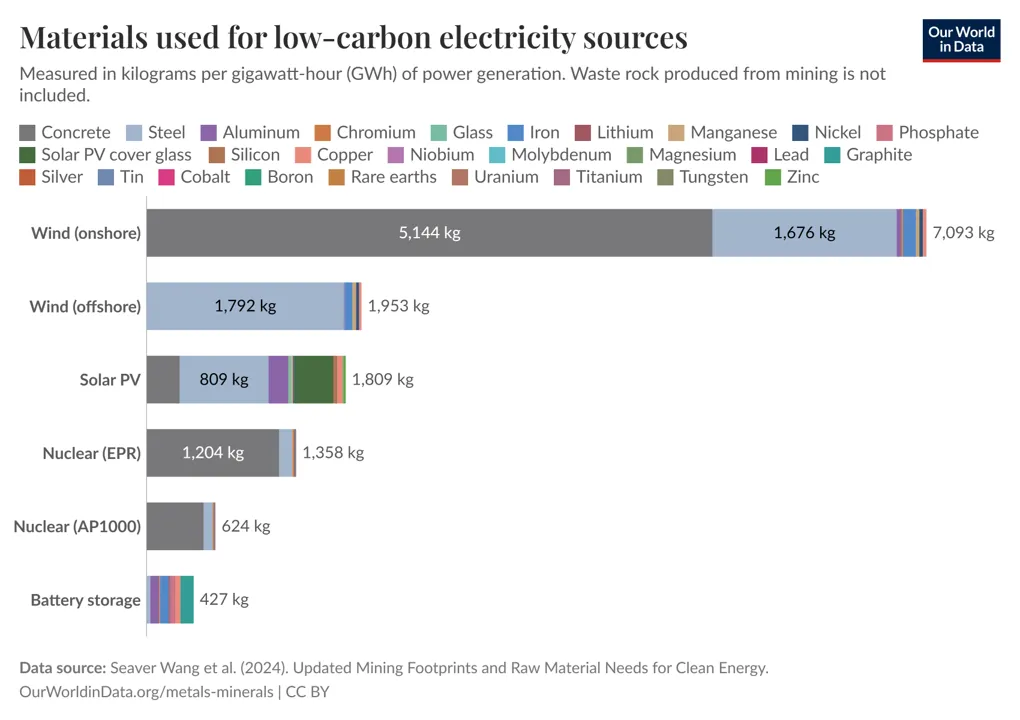
The IEA’s Net Zero by 2050 roadmap calls for solar PV capacity to increase 20x and wind power 11x. These increases require that annual solar additions must reach 630 GW per year by 2030 and wind must see annual increases of 390 GW. Battery storage must increase 14x to 1,200 GW by 2030.
These numbers imply an unprecedented mobilization of materials and industrial production. For example:
- The world currently produces about 1.9 billion tonnes of steel per year. Wind turbines are 71–79 percent steel by mass. The Energy Transitions Commission estimates that a net-zero energy transition requires 6.5 billion tonnes of end-use materials between 2022 and 2050, of which 95 percent is steel, copper, and aluminum — which is about three and a half years of current total global steel production.
- The world produces about 23 million tonnes (Mt) of copper per year. A January 2026 S&P Global study projects a 10 Mt copper shortfall by 2040. Mine development averages 17 years from discovery to production — That means that projects started today will not produce copper until the early 2040s.
The manufacturing of wind turbines, solar panels, and batteries at scale is not a niche activity in a few high-tech factories. It requires the sustained output of the entire global heavy industrial base — steel mills, cement plants, copper smelters, aluminum refineries, petrochemical complexes, glass furnaces, and the shipping networks connecting them. Every one of those industries currently runs on fossil fuels, with no commercial zero-carbon alternatives widely deployed in its most energy-intensive processes.
Making primary steel from iron ore — about 70 percent of global production — requires metallurgical coking coal in a blast furnace at around 1,500°C. Coal is not simply burned as fuel to create very high heat, it is also used in the chemical process that removes oxygen from iron ore to make iron. In 2023, less than 1 Mt of near-zero emission steel was produced globally, of a total global production of 1,889.2 Mt.
In its Net Zero 2050 scenario, the IEA projects that steelmaking in 2050 would still use significant coal — for ~22 percent of energy input — and theoretically paired with carbon capture and storage that does not yet exist at commercial scale.
The foundation under a wind turbine is reinforced concrete. Cement kilns run at around 1,450°C, and about two-thirds of cement’s CO₂ comes not from burning fuel but from a chemical reaction that happens regardless of what source heats the kiln. Full decarbonization of cement has been projected to double its cost and also requires industrial-scale carbon capture and storage that does not yet exist.
Solar panels are similarly carbon intensive. Producing solar-grade polysilicon requires smelting quartz at 1,500–2,000°C, followed by chemically intensive purification. According to the IEA’s Special Report on Solar PV Global Supply Chains, coal generates more than 60 percent of the electricity used in global solar manufacturing and in China, which dominates solar manufacturing, that figure exceeds 75 percent.
The glass covering a solar panel — about 75 percent of its weight — is made in furnaces at around 1,100°C fueled by natural gas or coal. The aluminum frame requires fossil-fuelled smelting. The silver contacts come from diesel-powered mines. Other materials come from petrochemicals. Then, panels are shipped around the world on vessels burning heavy fuel oil.
There is another category of fossil fuel dependency in solar panel and wind turbine supply chains: chemical feedstocks, necessary to create the many components necessary to assemble the final products.2 Wind, solar, and battery manufacturing necessarily depend upon the petrochemical industry, which the IEA projects will continue growing through 2050 in every scenario.
Batteries, necessary to store electricity when the wind does not blow and the sun does not shine, are fossil fuel intensive as well.3 Batteries last ~10–13 years, which means they need replacing two or three times over the life of wind or solar generation assets they are paired with, which have lifespans of ~25-30 years. Every replacement cycle is a full repeat of mining, smelting, and manufacturing.4
Wind turbines, solar panels, and batteries are products of the entire global industrial base. That base accounts for about 37 percent of global energy-related CO₂ emissions, with five heavy industries — cement, steel, oil and gas, chemicals, and coal mining — accounting for 80 percent of all industrial emissions.
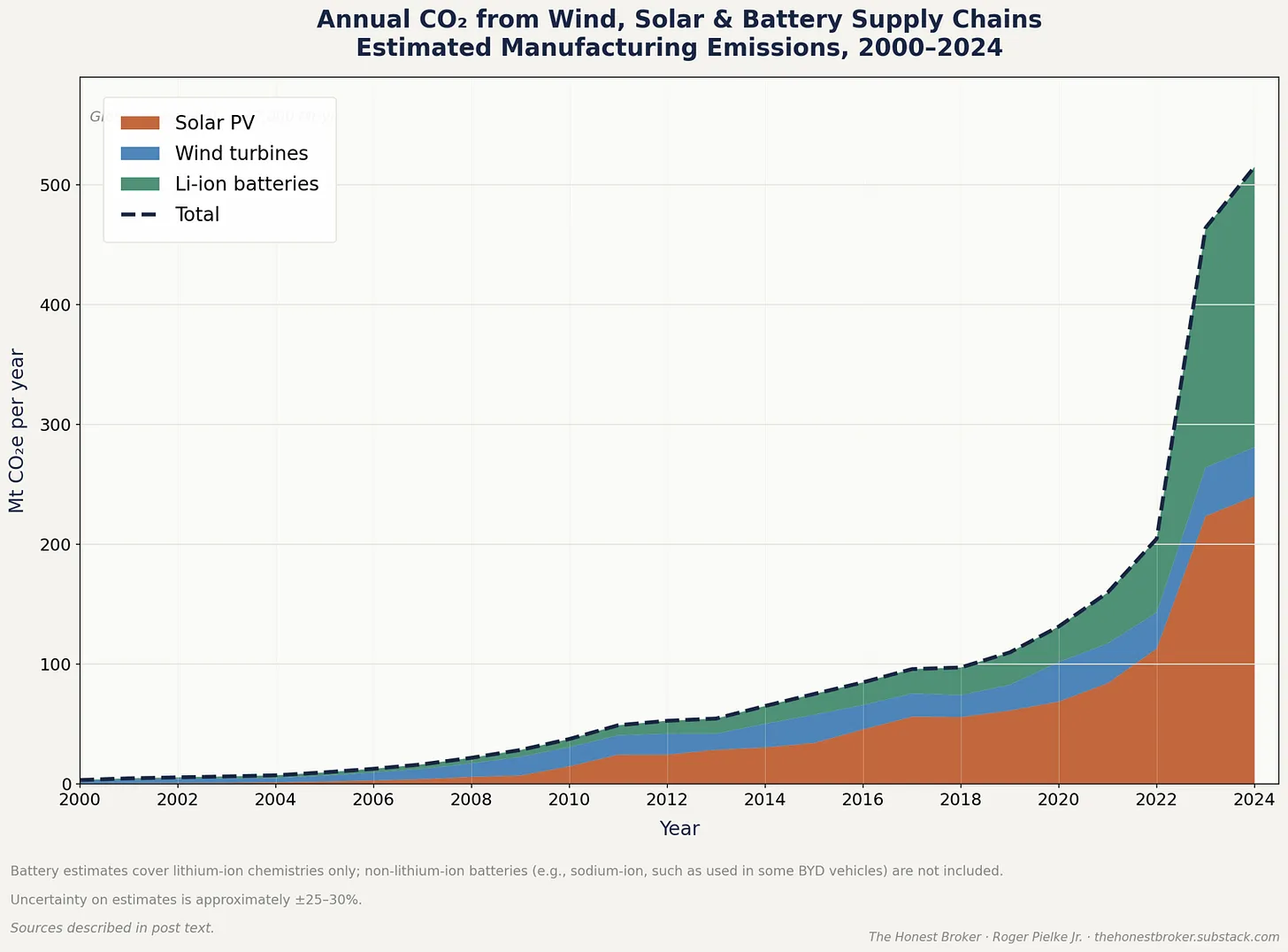
The figure below shows an estimate of the carbon dioxide (CO₂) emissions from manufacturing supply-chains for new wind, solar, and battery capacity. Annual emissions have grown from ~4 Mt in 2000 to ~470 Mt in 2023 — about 1.3 percent of global energy CO₂, and comparable to the total annual emissions of South Korea or Canada. That growth is a pure volume effect: manufacturing carbon intensity per GW has fallen substantially, but absolute emissions have risen because deployment scale has grown much faster than intensity has declined.
We can get a sense of the technological challenge of decarbonizing supply chains for wind and solar by looking at net zero scenarios and backing out what they imply in terms of needed resources. In a 2008 paper in Nature with Tom Wigley and Christopher Green, we called this a “frozen technology baseline” — If we freeze technologies at today’s level and then look at what projections imply for the future, that then tells use how much technological improvement is actually assumed in the scenarios. We argued that “it is only with a clear-eyed view of the mitigation challenge that we can ever hope to adopt effective policies.”
In the exercise, manufacturing carbon intensity is frozen at 2024 levels, and I explore implied carbon dioxide emissions implied to 2050. The point is not to predict the future. It is to isolate the effects of assumed technological innovation within scenarios.
Advances in technology do not occur on predictible schedules, however scenarios of deep decarbonization often assume JITTI — Just In Time Technological Innovation.5 JITTI allows scenarios to assume technologies necessary for deep decarbonization will appear at global and industrial scale just when the world needs them to transform the global energy system. Convenient!
The figure below shows projected CO₂ emissions from wind, solar, and battery supply chains projected to 2050 under a frozen technology baseline for the IEA’s net zero scenario (NZE), its stated policies scenario (STEPS), and a simple extension of the historical trend.6 The historical data in the figure is the same found in the figure above, which gives a sense of scale.
The results are incredible — and described in more detail below.
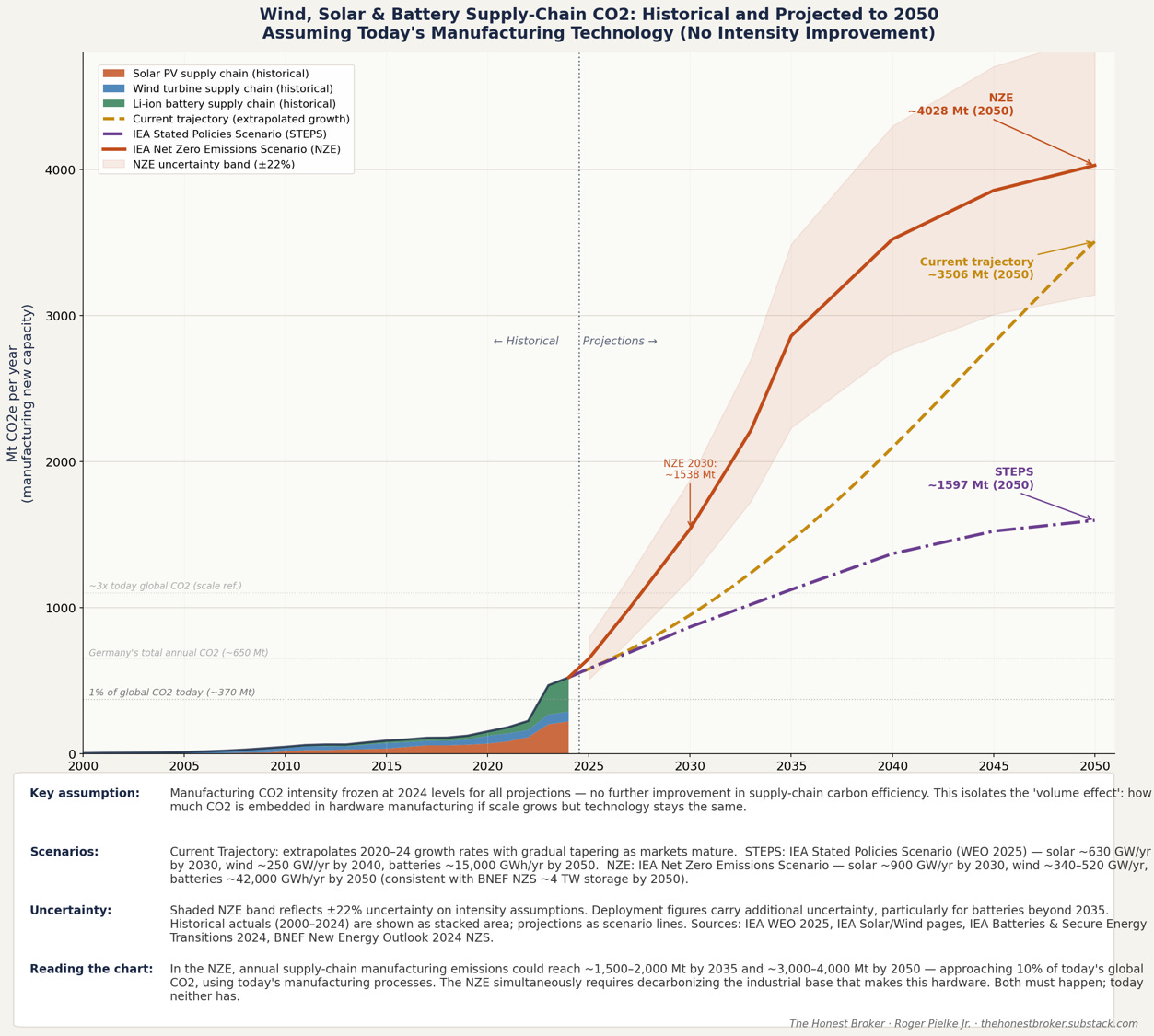
In the IEA’s Stated Policies Scenario (STEPS), annual supply-chain manufacturing emissions are ~870 Mt by 2030 and ~1,600 Mt by 2050. That 2050 figure exceeds Japan’s entire national CO₂ output today — with a population of 125 million and a $4 trillion economy — and approaches the combined annual fossil CO₂ of Germany, France, the United Kingdom, Italy, and Spain.
In the IEA’s Net Zero Emissions Scenario (NZE), supply-chain emissions are ~1,540 Mt by 2030 alone — similar to the combined emissions of Germany, France, and the United Kingdom. By 2050 in the NZE, the figure is ~4,000 Mt — comparable to the current annual fossil CO₂ of the United States, or ~10% of today’s total global emissions of carbon dioxide from energy.
The NZE scenario requires the most new infrastructure, so it generates the most supply-chain emissions under frozen technology assumptions. For deep decarbonization to occur, both the massive hardware build-out and the assumed decarbonization of the global industrial base must happen simultaneously.
Consider that the IEA NZE roadmap requires that every month from 2030 onwards, ten heavy industrial plants are equipped with carbon capture and storage, three new hydrogen-based industrial plants are built, and 2 GW of electrolyser capacity is added at industrial sites. That is the minimum background rate of industrial transformation required just to keep the scenario on track, independent of the deployment of wind, solar, and batteries across global grids.
The narrow focus on wind, solar, and batteries by many climate advocates obscures the fact that these technologies do not emerge spontaneously from zero carbon industrial processes. The steel industry accounts for roughly 7–9 percent of global CO₂ annually. Cement accounts for another 6 percent. Copper, aluminum, chemicals, and the petrochemical feedstocks woven through every component add more. These are industries with capital stock turning over only once every 25–40 years, where investment decisions made today lock in emissions profiles for decades.
Wind and solar do reduce overall emissions when they displace fossil generation on the grid. But the energy transition is not simply a story of replacing electricity generation from fossil fuels system with lower carbon alternatives. Far more importantly, it is a story of transforming the foundations of the global industrial base — and today, that transformation is a long way off.7
Scenarios of deep decarbonization have long assumed that technological progress would achieve what is required on schedules that align with political targets. The next time you hear numbers on the deployment of wind, solar, and batteries, acknowledge that reality, and then ask about rates of decarbonization in steel, cement, copper, aluminum, petrochemicals, glass, shipping and the other foundations of the modern world.