Last week in Belém, Brazil the 30th Conference of Parties to the U.N Framework Convention on Climate Change (UNFCCC) concluded with little accomplished, according to most observers.
Perhaps the most significant accomplishment was formalizing a fully Orwellian characterization of the recent history of climate policy — See my post last week for why the UNFCCC characterization of moderating trends in climate projections is straight up misinformation.
Below is an excerpt from the COP30 agreement that turns flawed scenarios into policy success:
Acknowledges that significant collective progress towards the Paris Agreement temperature goal has been made, from an expected global temperature increase of more than 4 °C according to some projections prior to the adoption of the Agreement to an increase in the range of 2.3–2.5 °C and a bending of the emission curve based on the full implementation of the latest nationally determined contributions, while noting that this is not sufficient to achieve the temperature goal;
Today, I ask and answer — When should the climate community have first recognized that its projections of future climate change were based on flawed scenarios and taken action to correct course?
The answer, in short, is 2017.
That’s when Justin Ritchie and Hadi Dowlatabadi published their seminal paper: [1]
Ritchie, J., & Dowlatabadi, H. (2017). Why do climate change scenarios return to coal? Energy, 140:1276-1291. [2]
That paper altered the trajectory of my own work on climate. It found that the scenarios underpinning essentially all of projective climate research and the basis for the IPCC assessments were fundamentally flawed. [3]
They argued:
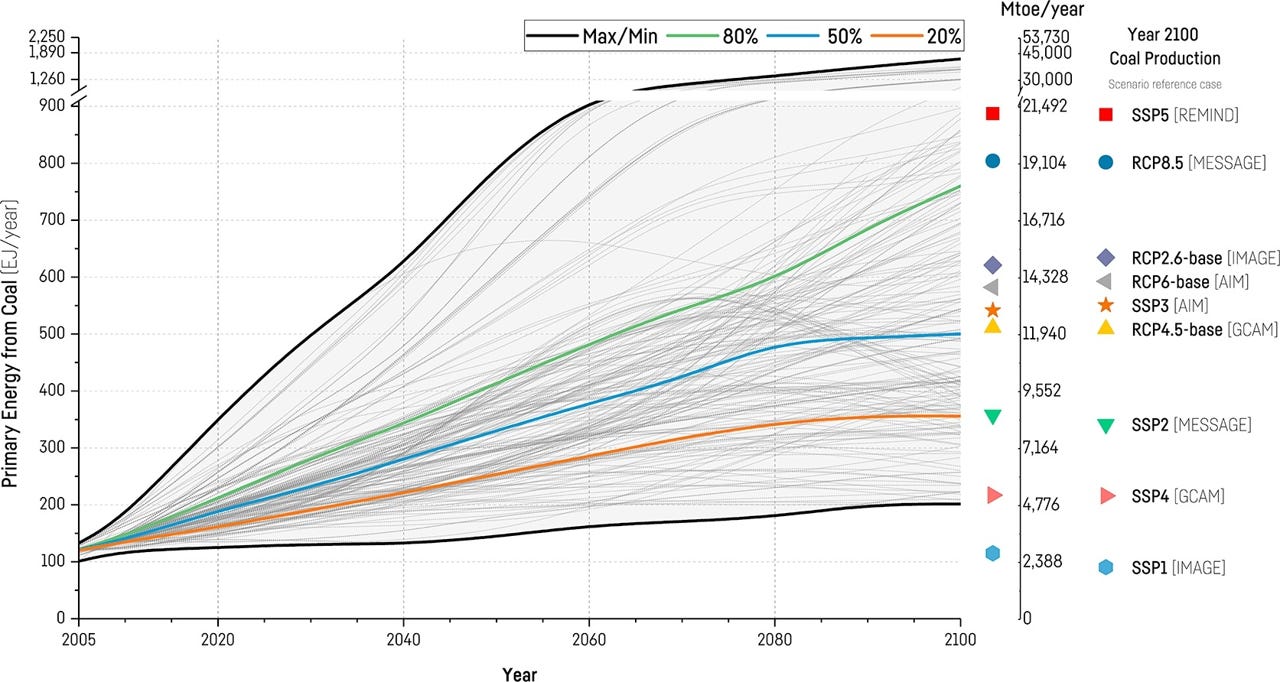
Thousands of scenarios, one common assumption — Coal consumption goes up, up, up. Source: Ritchie and Dowlatabadi 2017.
This paper finds climate change scenarios anticipate a transition toward coal because of systematic errors in fossil production outlooks based on total geologic assessments like the LBE model. Such blind spots have distorted uncertainty ranges for long-run primary energy since the 1970s and continue to influence the levels of future climate change selected for the SSP-RCP scenario framework. Accounting for this bias indicates RCP8.5 and other ‘business-as-usual scenarios’ consistent with high CO2 forcing from vast future coal combustion are exceptionally unlikely. Therefore, SSP5-RCP8.5 should not be a priority for future scientific research or a benchmark for policy studies.
Despite — or perhaps because of — its profound significance, Ritchie and Dowlatabadi 2017 was largely ignored by the climate science community. In the first three years after it was published, the paper was cited only 30 times.
The IPCC AR6 Working Group 3 cited the paper favorably in its Chapter 2, but failed to acknowledge that its conclusion — SSP5-RCP8.5 should not be a priority for future scientific research or a benchmark for policy studies — rendered much of the AR6 assessment out-of-date at best, as RCP8.5 studies were by far the most cited across the AR6 assessment.
Here is how the AR6 characterized their paper:
Ritchie and Dowlatabadi (2017) show that per-capita primary energy consumption in baseline scenarios tends to increase at rates faster than those observed in the long-term historical evidence – particularly in terms of coal use. For example, SSP5 envisions a six-fold increase in per capita coal use by 2100 – against flat long-term historical observations – while the most optimistic baseline scenario SSP1-Sustainability is associated with coal consumption that is broadly in line with historical long-term trends (Ritchie and Dowlatabadi 2017).
In 2020, Zeke Hausfather and Glen Peters brought Ritchie’s work to a much broader audience with an opinion article in Nature and in the process put a spin on Ritchie and Dowlatabadi’s work that was contrary to their systematic evaluation.
For instance, Hausfather and Peters suggested that RCP8.5 may have once been plausible, but climate policy “progress” put us on a better path:
Happily — and that’s a word we climatologists rarely get to use — the world imagined in RCP8.5 is one that, in our view, becomes increasingly implausible with every passing year. . . Assessment of current policies suggests that the world is on course for around 3 °C of warming above pre-industrial levels by the end of the century — still a catastrophic outcome, but a long way from 5 °C. We cannot settle for 3 °C; nor should we dismiss progress.
The Hausfather and Peters rehabilitation of RCP8.5 included their characterization of the scenario not as implausible, as concluded by Ritchie and Dowlatabadi, but rather, a “worst case scenario.”
Hausfather and Peters called for the continued use of RCP8.5:
When RCP8.5 or its successor SSP5-8.5 are deployed, they should be clearly labelled as unlikely worst cases rather than as business as usual.
The broader climate community found the Hausfather and Peters spin on Ritchie and Dowlatabadi to be much preferrable than the original, devastating analysis. Hausfather and Peters has now been cited more that 1300 times, often to justify the continued use of RCP8.5 as a “worst case scenario.”
Since the publication of Hausfather and Peters 2020, the two co-authors have gone in different directions.
Hausfather continues to be one of the staunchest defenders of the continued use of RCP8.5 as a plausible scenario of the future (albeit, with reduced likelihood) and, contrary to evidence, he continues to champion its purported original accuracy in projecting where the world was actually headed into the 21st century:
This move away from high-end emissions scenarios in the literature reflects a broader recognition that the world is undergoing an energy transition away from a future of continuing fossil fuel expansion (IEA, 2023). Fifteen years ago many researchers argued that “business as usual” would likely lead to a world 4 °C or 5 °C above pre-industrial levels by 2100 (Sokolov et al., 2009). Today the world is in a very different place; growth in CO2 emissions slowed notably over the past decade (Friedlingstein et al., 2023), and emissions are projected to plateau in coming years under current policies and commitments (IEA, 2023). Global investments in clean energy topped 1.8 trillion in 2023, nearly double the level of global investments in fossil fuels (IEA, 2023). . .
The reduced plausibility of high-end emissions scenarios has been widely recognized in recent years. The recent IPCC AR6 WG3 report (Riahi et al., 2022) noted that “high-end scenarios have become considerably less likely since AR5 but cannot be ruled out.” They also clarified that these do not represent current policy scenarios, but rather a world that actively reverses past progress, pointing out that “RCP8.5 and SSP5–8.5 do not represent a typical ‘business-as-usual’ projection but are only useful as high end, high-risk scenarios.”
For his part, Peters recent work focuses on improving the plausibility of scenarios used to inform research and policy. For instance, on the 1.5C temperature target Peters writes:
It is always possible to find arguments to make 1.5°C forever possible, but they increasingly diverge from reality. It is time to admit that the world will cross 1.5°C and the likelihood of returning below 1.5°C via overshoot is slim.
Another example is a recent, and excellent, new paper with Ida Sognnaes on the outsized influence of individual integrated assessment models on the resulting available ensemble of projections. The IPCC analyzes that ensemble as if it offers a meaningful statistical distribution of futures, technologies, and policies — Sognnaes and Peters suggest that it does not:
The current use of database statistics to present key scenario findings in IPCC reports might mean that targets and decisions are based on findings that are more reflective of idiosyncratic model or study assumptions than of the chosen climate target and the scenarios literature. Moving away from descriptive statistics that are difficult to interpret and sensitive to sampling might be more in line with both the goal of the IPCC, to assess the full scenarios literature, and the purpose of integrated assessment modelling, to provide insights, not numbers.
Few recognize the centrality of climate scenarios in climate science. The scenarios are also key to an incredibly wide range of policy discussions, proposals, and even implementation.
If scenarios are flawed — or more generously, just out of date — then projective climate science will also be flawed or out-of-date. Consider that so far in 2025 almost 10,000 studies — or about 30 per day — have been published using scenarios that are already falsified. [4] What a waste of effort and resources.
The climate science and policy community is at present struggling to cope with the fact that the real world has not evolved as foreseen by the scenarios that have been at the center of climate research for the past two decades.
Some deny that these scenarios were ever flawed. Instead, they argue, it is climate advocacy and climate policy that has rendered these previously accurate scenarios obsolete. That means we simply need to double down on the exact same climate advocacy and policies of the past decade or so to ensure continued progress towards deep decarbonization. The out-dated extreme scenarios should still be used, they argue, as a warning not to return to our bad old ways.
However, if the scenarios were fundamentally flawed from the beginning, that would mean that climate advocacy and policy have actually accomplished very little, and that new and different approaches to decarbonization are needed. As well, new approaches to the development and use of climate scenarios would also be needed — In short, everything must change.
Thus, the battle over climate science and policy past is also a battle over the future of climate science and policy, as well as who and whose ideas lead the way. Consequently, we should fully expect the rehabilitation campaign of discredited climate scenarios to continue and intensify.
[2] Other, such as Larry Kummer in 2015, had also identified problems with the RCP8.5 scenario. Ritchie and Dowlatabadi were the first to systematically evaluate the scenarios of the SSP/RCP framework, to identify their key flawed assumptions, and successfully publish their results in the peer-reviewed literature. The problems they identified are not limited just to RCP8.5.
[3] Ritchie and Dowlatabadi was published in December 2017. I gave my first talk on RCP8.5 the next month in Japan (where I got to spend time with Yoichi Kaya and discussed their paper). My first paper on RCP8.5 appeared soon after and I’ve been writing on flawed scenarios ever since — lucky for me, with Justin Ritchie, and Matt Burgess as well.
[4] Courtesy Google Scholar, and specifically, RCP8.5, SSP5-8.5, and SSP3-7.0.