

An Inconvenient Truth turns twenty next month. In the coming weeks, I am sure that there will be many retrospectives seeking to relitigate the scientific claims in the film. But the far more important anniversary story is not about the accuracy of any of Gore’s individual claims, but rather what the film helped to unleash in the scientific community: a decisive turn to bringing partisan politics into the institutions of science.
Gore did not simply make a film about climate change. He implored the scientific community to join him in overt climate advocacy. The fuel that Gore added to the fire of pathological politicization of the climate science community is the most important legacy of An Inconvenient Truth (AIT).
Almost three years after the release of AIT, Al Gore took the stage at the 2009 annual meeting of the American Association for the Advancement of Science (AAAS) in Chicago and delivered something much closer to a revival sermon than a scientific lecture.
On first glance, the venue for Gore’s jeremiad might have seemed odd. The AAAS was founded in 1848, and with more than 120,000 members in 2009, it is the most prominent and authoritative scientific association in the United States. In retrospect, it is clear that with AIT, Gore was not just speaking to the public — he was also recruiting the high priests of the secular apocalypse to his cause, and he did so brilliantly.
Fresh from two Oscars for AIT and a Grammy for its accompanying audiobook — awarded just days before — Gore told the assembled scientists that they could no longer “in good conscience accept this division between the work you do and the civilization in which you live.”
His directive to the assembled scientists was clear:
“Leave this city after this meeting and start getting involved in politics. Keep your day job, but start getting involved in this historic debate. We need you.”
The reception in the room was rapturous. The standing ovation Gore received from the scientists lasted over a minute until he left the stage.
The AAAS press release celebrating the occasion described Gore’s appearance in terms more suited to a rock star prophet. James McCarthy, the Harvard oceanographer serving as AAAS president — and himself an adviser on the original 2006 documentary — effusively praised Gore’s political call to arms:
“No single individual deserves more credit . . . for our public acceptance of climate science—public acceptance that has emboldened growing numbers of mayors, governors, senators, and presidential candidates to embrace the urgency of addressing anthropogenic climate change.”
To understand the underlying dynsmaics, it helps to understand how catastrophism came to take root in the climate science community — and also how science came to play a central role in catastrophism.
In 1983, Michael Barkun, a professor at Syracuse University, identified the rise of a “New Apocalypticism” in American life. He described a secular variant of religious millenarianism — rooted not in scripture but instead in science, yet structurally identical in its essential features.
Barkun explained:
“The so-called “New Apocalypticism” is undeniably religious, rooted in the Protestant millenarian tradition. Religious apocalypticism is, however, not the only apocalypticism current in American society. A newer, more diffuse, but indisputably influential apocalypticism coexists with it. Secular rather than religious, this second variety grows out of a naturalistic world view, indebted to science and to social criticism rather than to theology. Many of its authors are academics, the works themselves directed at a lay audience of influential persons — government officials, business leaders, and journalists — presumed to have the power to intervene in order to avert planetary catastrophe.”
Gore’s orations perfectly followed the script of the “New Apocalypticism”: The identification of an existential crisis, the diagnosis of human sin as its cause, the urgency of transformation, and the comfort of redemption for those who heed the warning. The climate science community readily embracted this script and adopted the language of believers and deniers to differentiate those with faith and those yet to be converted, and who risked excommunication.
Barkun explained that scientific “predictions of “last things” generate the feelings of awe that have always surrounded eschatology, even if in this case the predictions often grow out of computer modelling rather than Biblical proof-texts.”
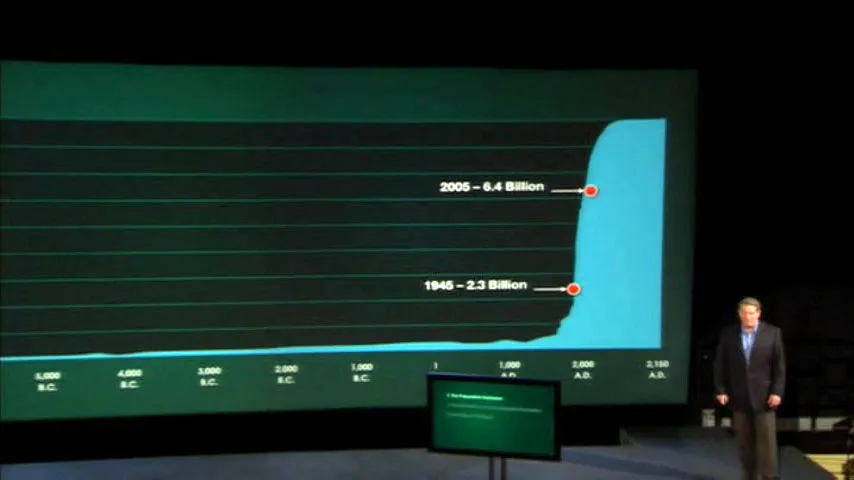
Gore was an extraordinarily skilled evangelist and he took his message to scientists on their own terms — with a PowerPoint presentation.
But even so, An Inconvenient Truth was not really about science; it was a sermon — complete with a moral arc (with those who are evil and those who are righteous), a clear account of sin (fossil fuel emissions), a warning of coming judgment (floods, storms, tipping points), and a path to redemption (political will, renewable energy, personal responsibility). The film ends with a call to conversion.
Gore was part of a broader trend in which leaders of the scientific community were increasingly associating themselves with Democratic politics. When he stepped onto the stage in Chicago, he was already a liberal cause célèbre — and he knew exactly the choir he had assembled before him.
Matt Nisbet’s Climate Shift helps to explain why scientists at AAAS were so receptive to Gore’s message. In 2009, >50% of AAAS members self-identified as liberal or very liberal, just 9% as conservative — and 55% identified as Democrats versus just 6% as Republicans.
The figure below, from Nisbet’s report, shows that AAAS members self-reported being more partisan and more ideological than Fox News viewers on the right and MSNBC viewers on the left.
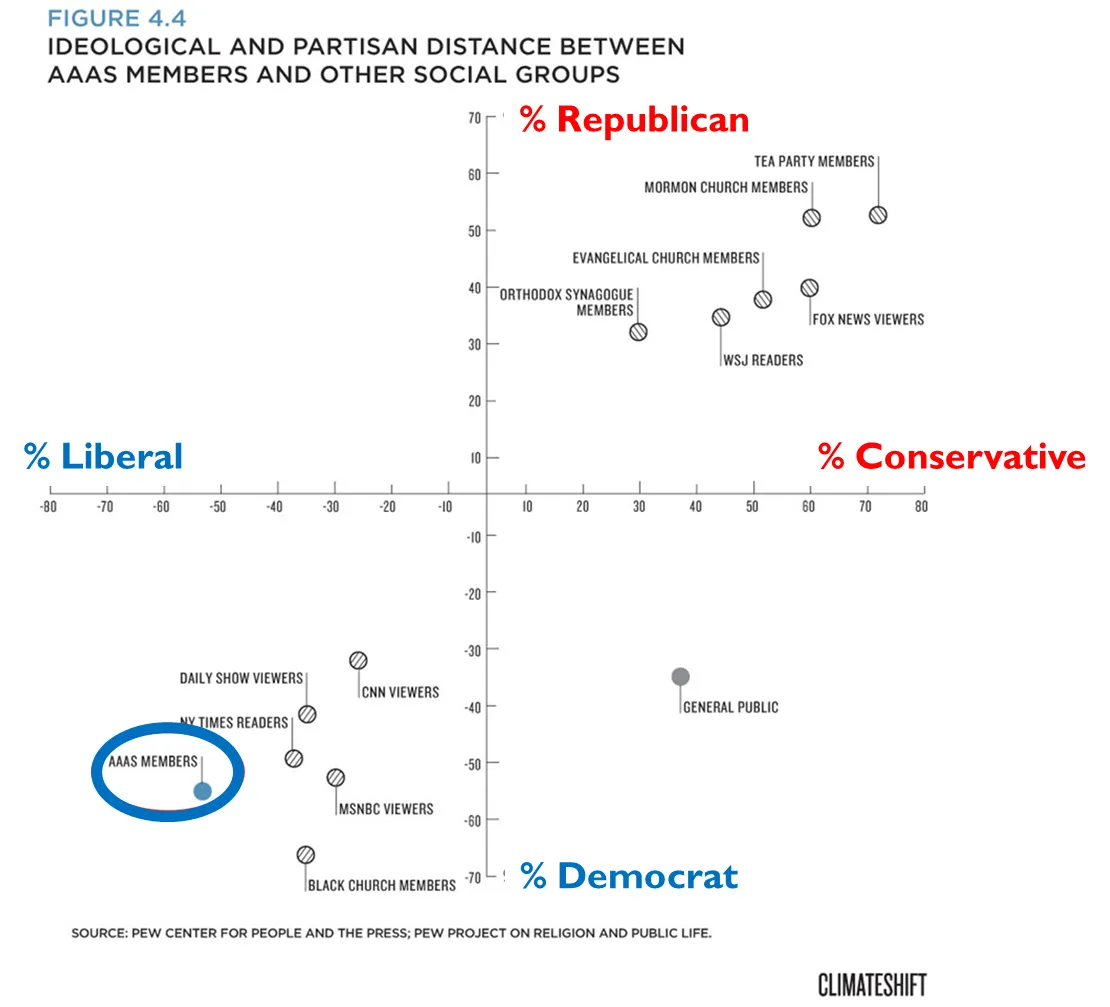
Nisbet observed, “AAAS members rank among the most like-minded” of any major social group in the United States. At the 2009 AAAS meeting in Chicago, Gore was not speaking to an audience with political views that resembled the American public. He was speaking to an audience that was, by its own description, already supportive of the politics and ideology that his message reinforced.
Looking back, my reaction to Gore’s AAAS talk focused on its substantive content, not its symbolic significance. I missed the forest for the trees.
Two days after Gore’s Chicago sermon, on Prometheus — the popular science policy blog hosted at the university center I directed — I called out Gore for including scientifically incorrect claims in his lecture.
I pulled no punches:
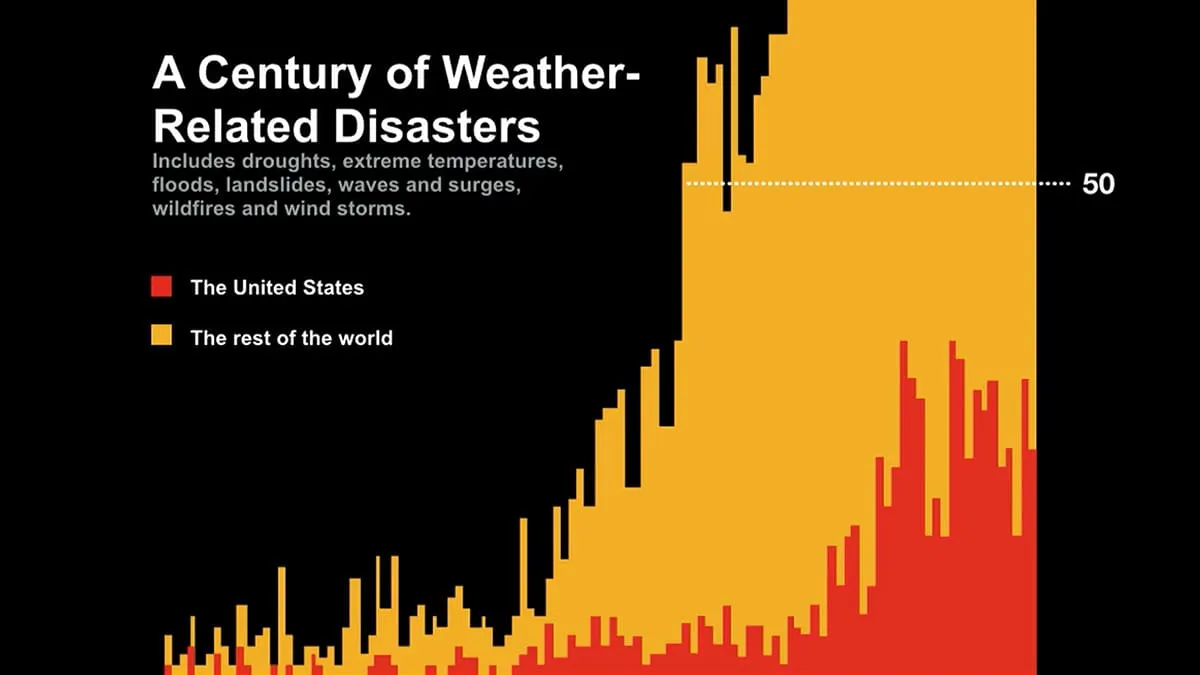
“In his speech Gore attributed a wide range of recent weather events to human-caused climate change including floods in Iowa, Hurricane Ike, and the Australian bush fires. Gore sought to sum up all of these weather anecdotes by citing data from the CRED in Belgium showing that the total number of disasters has increased in recent decades.”
For his AAAS lecture, Gore had updated his famous slideshow from the original film with some new slides. Near the end of his talk, he showed a graph from the Centre for Research on the Epidemiology of Disasters — CRED — displaying a dramatic upward trend in weather-related disaster events, which he used to argue that climate change was already producing “weather-related disasters that are completely unprecedented.”1 A snippet of that slide can be seen above.
As THB readers well understand, the CRED time series on disasters cannot be used to say anything about trends in weather phenomena. We should always use climate data to investigate climate trends, not data on economic losses or casualities.
In the days following my critique, Andy Revkin of the New York Times asked Gore’s representatives for their reaction. CRED issued a statement that backed me up, which was no doubt more important than my critique for what came next.
Within days, Gore’s office confirmed they were pulling the slide that argued that increasing disasters counts signifiyed increasing extreme weather caused by accumulating greenhouse gases.
His spokesperson’s statement:
“We appreciate that you have pointed out the issues with the CRED database and will make the switch back to the data we used previously to ensure that there is no confusion either with regards to the data or attribution.”
At the time, I thought that getting Gore to correct the factual record was a victory for scientific integrity.
I was wrong. The real issue was not the science, but the sermon.
I was on the right track, though. In my critique of the disaster slide, I reserved my strongest criticism not for Gore — he is after all a campaigning politician, not a scientist — but for the scientists in the room who happily cheered on being told false information.
I wrote:
How did AAAS and the many scientists in attendance respond to being blatantly misled with scientific untruths in a speech calling for political action?
Why, by issuing a press release repeating the misrepresentation:
“With charts and images, Gore described the immediate nature of the threat . . . A 500-year flood that has wrecked Cedar Rapids, Iowa. Wildfires in Greece that nearly toppled a government, and wildfires this month in Australia that have left scores of people dead and sparked a new national debate about climate change.”
. . . as the non-response to Al Gore’s in-your-face untruths shows, the misrepresentation of climate science for political gain has many willing silent collaborators.
Climate science, in the years following An Inconvenient Truth, increasingly took on the role of secular exegesis — the interpretation of extreme weather events, polar bear photographs, and pretty much anything-that-just-happened as signs confirming a narrative of planetary emergency requiring repentance.
To be fair, in his film, Gore did get many of the basics correct:
- Humans are warming the planet. The physical claim at the film’s foundation that rising CO₂ warms the planet was (and still is) well-established.
- The Arctic. Gore was correct that Arctic summer sea ice was in decline with human influences playing an important role.
- Global glacier retreat. Gore’s argument that mountain glaciers worldwide were retreating in a spatially coherent pattern consistent with warming was correct — IPCC AR6 Chapter 9 in 2021` confirms that global glacier mass loss has accelerated since the 1990s and attributes the decline to human-caused warming with high confidence.
Gore also got some things very wrong:
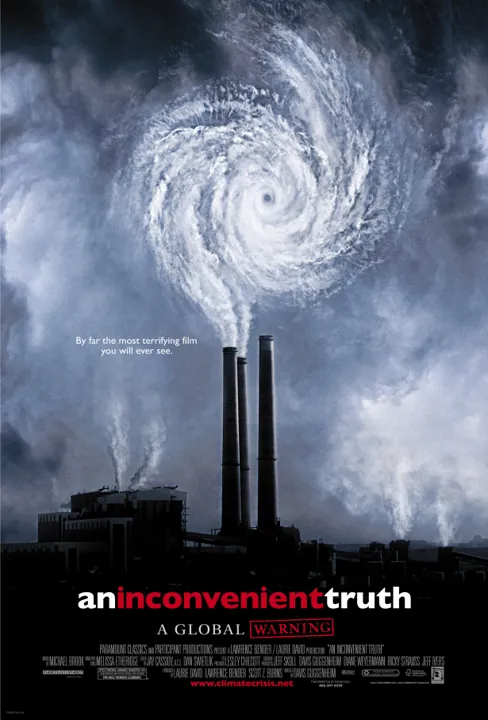
- Hurricanes. The theatrical poster — a hurricane emerging from an industrial smokestack (shown above) — strongly suggested causality. Gore presented the active 2005 Atlantic hurricane season as part of an ongoing trend. Ironically, for more than a decade after AIT was released not a single major hurricane made landfall on the continental United States, and today the science of tropical cyclones still does not support claims of detection or attribution of trends, with high confidence.
- Sea level rise. Gore claimed that melting ice sheets could produce twenty feet of sea level rise “in the near future,” accompanied by animated maps drowning present-day Manhattan and south Florida. Gore’s claims departed significantly from the IPCC then and now, without acknowledging that he was advancing fringe views.
- Lake Chad misattribution. Gore presented the shrinkage of Lake Chad (bordered by Nigeria, Niger, Chad, and Cameroon) as a consequence of climate change. He should have known better: Coe and Foley (2001) attributed about half the lake’s decline to agricultural water extraction, with multi-decadal Sahel rainfall variability accounting the rest. Today, ironically, increased rainfall and flooding in the Lake Chad region is also blamed on climate change.2
Looking back, I can see my error in interpreting what was going on — I thought Gore was misusing science to support political claims.
That was not quite correct.
Instead, something much deeper was going on: Gore was using science symbolically to preach the gospel of the “New Apocalypticism” — and scientists rose to their feet to give an “Amen.”
Looking back from 2026, Gore’s homily has aged poorly:
“We have everything, save perhaps political will — but political will is a renewable resource.”
The science is settled, the solutions exist, the only obstacle to salvation is to elect the right politicians. If we do that, we avoid catastrophe.
That framing swept through media, governments, and much of the scientific community. On every count, Gore’s thesis has not stood the test of time.
- We are not on the brink of apocalypse. The world has continued to warm, due to accumulating carbon dioxide emissions. Of course, catastrophists are still with us, and surely always will be, but research has not supported the claims that humanity faces an existential threat. Most significantly, the most extreme climate scenarios that have dominated climate science and policy are not plausible. As a consequence, estimates of 2100 warming under “current policies” have declined from ~4°C to ~2.5°C. No one need take that from me, take it from the IPCC and UN FCCC.
- Most types of extreme weather have not become worse. Floods, drought (hydrological and meteorological), tropical cyclones, and tornadoes have not had detectible changes according to the IPCC’s Sixth Assessment Report. Some signals have emerged — heat waves have become more frequent and heavy precipitation has increased in some regions. However, the fire and brimstone of AIT remains far from reality.
- The societal impacts of weather and climate have dramatically lessened. Weather-related disaster losses as a share of global GDP show no upward trend, deaths from natural disasters have fallen dramatically over the past decades even as the global population has increased, and societal vulnerability has decreased dramatically. Wealthier societies build stronger buildings, maintain better early warning systems, invest in flood defenses, and can afford to evacuate. A richer world is a more resilient world.
- We do not have all the technologies we need. Solar and wind costs have fallen dramatically — any time energy costs decrease, that is good news. But decarbonizing industrial heat, long-haul shipping, aviation, steel, cement, and agriculture remains unsolved at scale. Treating the human influence on climate as a purely political issue totally misdiagnoses the challenge.
- There is plenty of political will. Public opinion, the EU Green Deal, and net-zero targets covering most of the world’s GDP are examples of levels of political will3 that would have seemed extraordinary in 2006 — even if these collectively will not lead to net zero by 2050. The problem is not will. As I argued in The Climate Fix, the iron law of climate policy remains undefeated: when climate policy conflicts with economic growth, growth wins. Net zero at any cost forces this conflict — demanding emissions reductions faster than technology permits, then blaming politics when targets cannot be met.
An Inconvenient Truth and its aftermath provided a lesson yet to be fully appreciated: Political exhortation grounded in “science” will not drive the technological change required for global transformation. Technology and politics must evolve together, with “science” playing a supporting but not central role. Efforts to leverage science as the basis for motivating political transformation will compromise the integrity of scientific institutions rather than transform global politics. When that happens, we all suffer.
When the climate science community chose to organize itself as a political movement behind a charismatic preacher, that helped turn many institutions of climate science into what Barkun described as part of the “New Apocalypticism” — a secular eschatology, in which science exists not to advance understandings in all of their complexities, but instead to confirm Manichean belief.
The cost of that choice — in public trust and in the scientific community’s capacity to self-correct — is still being paid.