

In legal disputes, it is common for issues related to science and expertise to play a central role. Is an epidemiological study reliable? What does DNA evidence actually prove? How should contested statistical methods be weighed?
For three decades, the Federal Judicial Center (FJC), which supports research and education within the federal judicial branch of government, and the National Academies of Sciences, Engineering, and Medicine (NASEM) have provided judges with a resource created to help them better understand science and the law — the Reference Manual on Scientific Evidence.
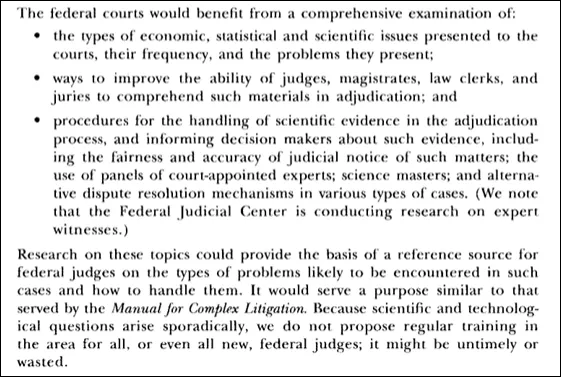
The Manual’s origins go back to 1988, when Congress directed the Judiciary to empanel an expert committee to assess problems with the performance of federal courts and recommend options for improvement. The resulting report, published in 1990, recommended a need for improved guidance for judges on how to handle complex issues of science and technology, and suggested the creation of a reference manual (see the excerpt in the screenshot below).
Soon after, the Supreme Court in 1993 issued its Daubert v. Merrell Dow Pharmaceuticals decision that instructed judges that they have “some gatekeeping responsibility” for evaluating expert scientific testimony before allowing it before a jury.
The FJC published the First Edition of the Reference Manual in 1994, and it has been updated roughly every decade since, with editions in 2000 and 2011. The Third Edition represented, for the first time, a joint effort with NASEM, funded by the U.S. National Science Foundation and the Gordon and Betty Moore Foundation.1
The Fourth Edition, published without fanfare on New Year’s Eve 2025, included a new chapter on climate change not present in previous editions: a Reference Guide on Climate Science. This is where things get interesting.
Almost immediately after the publication of the Fourth Edition of the Manual, Republicans in the U.S. Congress called the climate chapter “biased,” writing to the FJC with concerns that the materials in the Manual “appear to be designed to bias judges in climate-related cases.” Soon thereafter, the FJC announced that it would remove the chapter from the Manual. However, the NASEM said that it would stand behind the climate chapter, and leave it in its version of the Manual on its website.
That was just the beginning of a continuing controversy.
- Congressional Democrats want an investigation of why the FJC removed the climate chapter;
- State Attorneys General, 27 of them and all Republicans, want an investigation of why the NASEM has not removed the climate chapter;
- Some authors who wrote other chapters in the Manual penned an open letter decrying a “political attack by the attorneys general on a carefully and rigorously prepared scientific publication should concern us all”;
- The two authors of the climate chapter wrote their own 10-page defense of their effort.
At the center of the controversy are claims that the chapter’s authors have conflicts of interest or compromising biases. These claims are not wrong, as I’ll show.
However, there is a far more fundamental problem that has received less scrutiny: The climate chapter was ghost authored in violation of established scientific integrity standards.
The conflicts of interest and biases makes this situation much worse. But the ghost authorship alone would be a serious problem even if the unacknowledged author was a completely disinterested party.
In public comments defending the climate chapter, Brenda Eskenazi, of the University of California, Berkeley School of Public Health and a co-author of the Manual’s chapter on epidemiology, argued:
If I tell you how much peer review we went through, how much anonymous review, how much vetting we went through for each of the chapters, and then for some 27 politicians to come in and say, ‘No, we don’t accept this science,’ is just appalling. It’s appalling that this could become something political when it’s really about science, unbiased science. If it was biased, that would have been called out in all of the reviews.
In reality, the FJC Manual represents a failure of scientific integrity. Let’s take a look . . .
Ghost authorship refers to when a substantial intellectual contributor to a work is unacknowledged as an author.2 The International Committee of Medical Journal Editors (ICMJE) — whose authorship standards are a reference point across scientific publishing — is explicit: any individual who made a substantial contribution to a work, drafted and critically reviewed intellectual content, gave final approval, or accepts accountability for it must be credited as an author.
Relegating such a person to the acknowledgments is not a technicality. It is a violation of publication ethics. The Committee on Publication Ethics (COPE) treats ghost authorship as a form of research misconduct requiring correction of the authorship record.
The reason ghost authorship is taken seriously — in medicine, in the sciences, across research fields — is that authorship is not merely about credit, but accountability. Readers, peer reviewers, and the public rely on the author list to assess who performed the work resulting in publication, what their expertise and perspectives are, and what interests they may bring to the effort. Strip that information out and you undermine a central basis for trust in science and science as applied to policy.
Before getting to the ghost author, the chapter’s two named authors, Jessica Wentz and Radley Horton, were curious choices by the NASEM to be authors of a chapter on climate change and the law — in a supposedly neutral judicial reference guide.
Wentz and Horton are both affiliated with Columbia University’s Sabin Center for Climate Change Law, an institution whose mission is to advance climate litigation:
The Sabin Center develops legal techniques to combat the climate crisis and advance climate justice . . .
Wentz, a legal scholar and Sabin Center non-resident senior fellow, has published extensively promoting climate litigation, co-authored a piece titled, “Holding Fossil Fuel Companies Accountable.” Horton is a research professor at Columbia’s Lamont-Doherty Earth Observatory and a long-time collaborator on the Sabin Center’s work in support of climate litigation.
The decision by the NASEM to select Wentz and Horton to co-author the chapter deserves scrutiny, independent of any other issues of substance or process.
However, the issues do not stop there — this is just the tip of the iceberg.
The FJC Manual’s chapter on climate change footnote 77 on p. 1586 notes curiously that its,
discussion of attribution research has been adapted, and, in some cases, excerpted from the authors’ prior publications on this topic.
The footnote references a 185-page law review article published in 2020, that Wentz and Horton co-authored with a third co-author — The Law and Science of Climate Change Attribution, published in the Columbia Journal of Environmental Law.
The lead author of that 2020 article was Michael Burger, the Sabin Center’s Executive Director. That article explicitly addressed how attribution science can be used in climate litigation and concluded that the body of attribution research was “sufficiently robust to support the adjudication of certain types of legal disputes.”
Using Claude AI, I conducted an analysis comparing the text of the FJC climate chapter with Burger et al. (2020).
The findings are unambiguous — Significant parts of the FJC chapter were taken from Burger et al. 2020, with quantitative details in the table below.
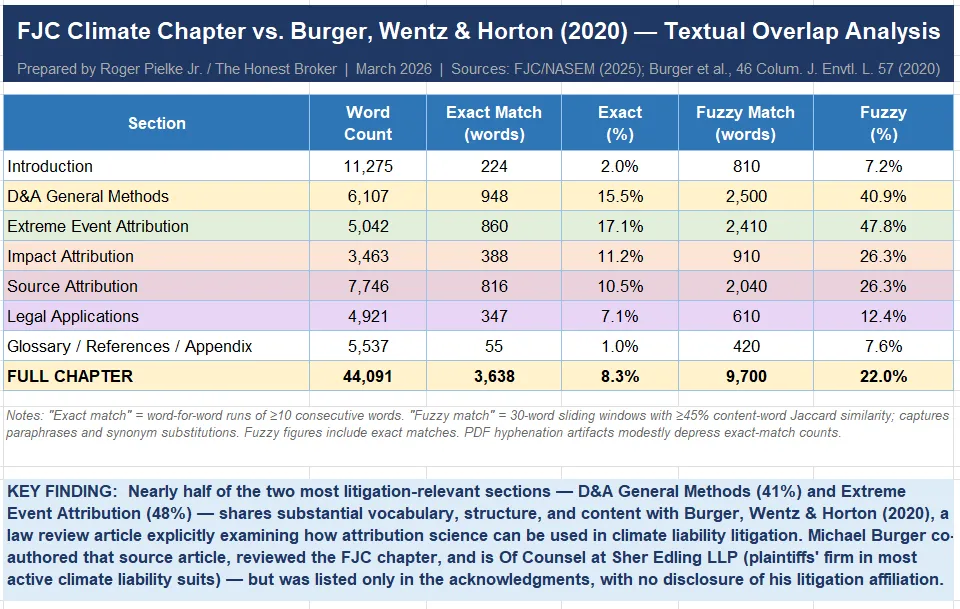
Exact word-for-word matches of ten or more consecutive words and lightly reworded passages account for 41–48% of overlap in the Detection & Attribution Methods and Extreme Event Attribution sections of the chapter — arguably the most relevant to climate litigation.
A spreadsheet at the bottom of this post includes dozens of examples of overlapping text between the two documents.
The data are not ambiguous: Michael Burger co-drafted the source text that comprises nearly half of the chapter’s most substantive sections related to climate litigation, and he is acknowledged in the paper as a pre-publication reviewer of the chapter, meaning that he satisfies two independent authorship criteria as outlined by the ICMJE.
Clearly, he should have been listed as a co-author of the chapter.
Regardless of who Michael Burger is — or what any of us think about climate change or climate litigation — ghost authorship is a violation of scientific integrity.
But who Michael Burger actually is makes this much, much worse.
Michael Burger is Of Counsel at the law firm Sher Edling LLP, the law firm representing most of the cities and counties currently suing fossil fuel companies, and counsel of record for Honolulu in its active climate lawsuit. Further, according to its website, the Sabin Center he leads at Columbia University has been funded by ClimateWorks Foundation, the Rockefeller Family Fund, and others in support of climate litigation.
Given these roles, inclusion of his name in the FJC climate chapter author list would have triggered an immediate and obvious red flag. Instead, the ghost authorship — which seems fairly obvious, despite footnote 77 — was missed in the extensive peer review process overseen by the NASEM.
Burger’s role as a ghost author of the FJC climate chapter is a sufficient basis for its retraction.
The peer review shortfall does not stop here. The FJC climate chapter includes an egregious misrepresentation of a finding of the Intergovernmental Panel on Climate Change (IPCC). The chapter asserts that the IPCC expressed “confidence in extreme-event attribution.”
However the IPCC, did no such thing.
The FJC climate chapter asserts (emphasis added) with a truncated quote:
. . . confidence in extreme-event attribution has advanced significantly as a result of “better physical understanding of processes, an increasing proportion of the scientific literature combining different lines of evidence, and improved accessibility to different types of climate models (high confidence)
However, the actual text of the IPCC says nothing about “confidence in extreme-event attribution,” but rather “about past and future changes in weather and climate” (emphasis added):
. . . confidence about past and future changes in weather and climate extremes has increased due to better physical understanding of processes, an increasing proportion of the scientific literature combining different lines of evidence, and improved accessibility to different types of climate models (high confidence).
The change in meaning of what the IPCC actually said is both undeniable and illustrative of the Manual’s apparent efforts throughout to suggest that extreme event attribution — created to circumvent peer review and “with the courts in mind” — has greater scientific standing that it does in reality.3
The IPCC AR6 was actually far more equivocal about extreme event attribution:
The usefulness or applicability of available extreme event attribution methods for assessing climate-related risks remains subject to debate.
This brings us to NASEM, which is where the failures of scientific integrity described above should have been identified and mitigated, long before the FJC Manual was written and distributed to federal judges. However, the evidence suggests that the NASEM did not just fail to notice these failures, but was (and continues to be) complicit in them.4
For today, I’ll leave the last words to Jessica Weinkle, who has followed this issue as close as anyone over at Conflicted:
The Reference Manual controversy suggests NASEM is as good as captured by its philanthropic funders and their political agenda. If one wanted to move the needle on this sad situation and rebuild public trust in science to improve societal stability, then holding the FJC and NASEM to account is an ideal place to dig in. The end game should be to identify and scrutinize undesirable conduct and processes that clash with public expectations of an ethical research enterprise. Both entities are created by Congressional statute, so it is well within legislators’ purview to demand and deliver a public account of what is happening in science’s dark corners.