

Back in 2000, the Organisation for Economic Co-operation and Development (OECD) published a graph showing that four countries with unmetered pricing policies for local dial-up internet calls—the United States, Canada, Australia, and New Zealand—led the world in a combination of investment metrics (internet hosts and secure servers) deemed indicative of the sophistication of their internet economies. (See Figure 1).
Figure 1. Always-On Zones of Communication (Internet Host Penetration and Secure Server Penetration)
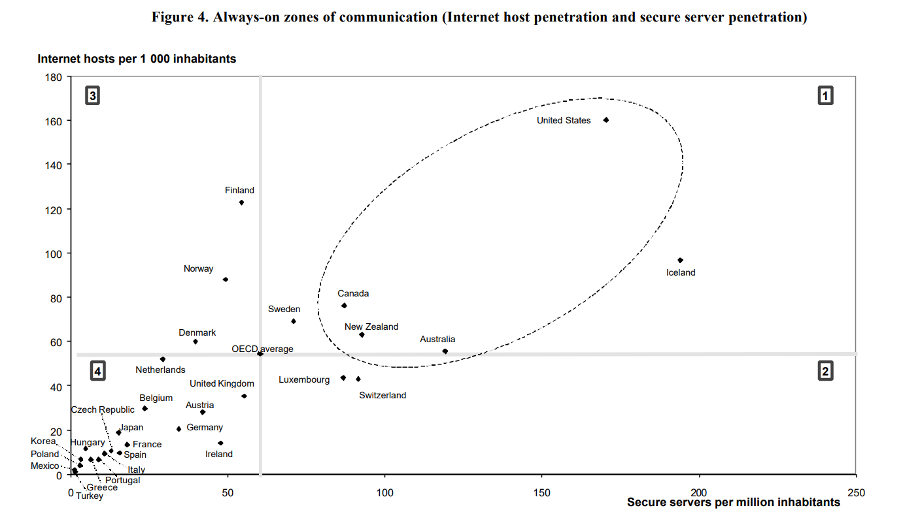
Source: Lewis Evans et al., “The State of e-New Zealand” (working paper, New Zealand Institute for the Study of Competition and Regulation, September 2000), 33, fig. 4, https://ir.wgtn.ac.nz/handle/123456789/19007.
As internet users in these countries faced no per-minute charge for telephone time spent connected to their internet service provider (ISP), they spent more time online and enjoyed greater internet economy benefits than users in Europe, where per-minute charging was the norm. Greater demand went hand in hand with greater investment in infrastructure to support the information economy. The OECD’s policy prescription: Governments wanting to emulate greater levels of internet sophistication should follow suit. The result was an ISP business model of “all you can eat” (i.e., flat-rate) internet access pricing that has dominated to this day.
Flat-rate pricing gelled well at the time with the concomitant thrust in telecommunications regulation. As the marginal costs of moving internet traffic were close to zero (almost all the costs of a telecommunications network are in the fixed-cost infrastructure), there was a strong belief this should be reflected in a comparable marginal price. Arguably, the costs of tracking and billing usage were just not worth the effort. An aphorism of the day (usually credited to Stewart Brand) that “information wants to be free” (“free” meaning no charge, or gratis) captured the ethos. Policy and regulatory pressure for flat-rate pricing of ISP access combined with technological innovation and competitive pressures to regularize the situation. Internet users became disconnected from the cost consequences of their network usage—congestion affecting other users, and the question of how infrastructure upgrades (including deployment of new fiber networks) should be funded as demand grew faster than under usage-based charging.
The concept of gratis internet usage expanded beyond ISP connections to website use and two-sided internet platforms—although such usage might come with the obligation to view advertisements paid for by others or accept data facilitating platform operators’ ability to charge more to the funding side of the platform.
The advent of generative AI tools, however, has been accompanied by a very different charging model. While access to ChatGPT, Gemini, Claude, and the like may have been at no cost to the user in the platforms’ very early days, as usage has increased, so too has the incidence of charging for use. Free access to AI remains, but with significant limitations. Serious users of these tools are now accustomed to paying for more use, access to more sophisticated versions with more extensive capabilities, and more sophisticated outputs. “All-you-can-eat” ISP-type offers just don’t exist.
With respect to costs, it is quite reasonable that increasingly sophisticated AI usage should be accompanied by higher fees. In addition to a significant fixed-cost component in tool development and data-center construction, there are also significant marginal costs associated with the electricity and water usage for these applications. And arguably, the AI operators have learned from how the telecommunications sector has struggled to recover costs of upgrading networks with their zero-usage-price payment models.
However, AI pricing also uncovers the much less frequently discussed aspect of “information wants to be free” carried in the concept of freedom as unrestricted access (“libre”). As Kenneth Arrow identified in his seminal 1962 paper on resource allocation in knowledge creation, if new information is to be created, there must be financial incentives from restricting the rights to see and use it and charging for its distribution. This is the inherent tension between gratis and libre information. While free (gratis) access to public good information and knowledge is well accepted, such information is not truly free (libre). The costs of its creation are underwritten by the creators, often institutions such as universities and research centers that choose to distribute some of their rights, making their intellectual property free to access and read while retaining institutional copyright. Any use is subject to these constraints.
Here, access by AI models to copyright creations for training results in objections by rights holders when permission to use their works is neither sought nor compensated. These works are not unrestricted (libre), so uncompensated (gratis) access is unsustainable if continued creation of new works is to be incentivized. A limited case for gratis information transportation (in a static context, if not the dynamic one) does not translate across to non-libre information. The question of what should be paid, and how, to copyright holders now forms part of the AI business model.
The importance of distinguishing between gratis and libre information is as important now as it has always been.