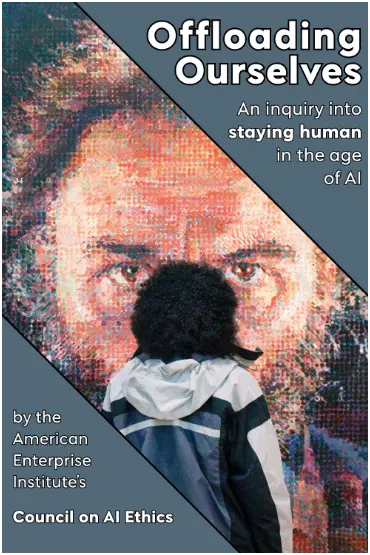
A PROJECT OF:

The American Enterprise Institute’s Council on AI Ethics is an initiative of the Center for Technology, Science, and Energy (CTSE), led by AEI Senior Fellow and CTSE Director M. Anthony Mills. Inspired by President George W. Bush’s President’s Council on Bioethics, which was initially chaired by AEI Senior Fellow Emeritus Leon R. Kass, the Council on AI Ethics convenes 19 scholars and practitioners from a range of institutions, including technical experts as well as ethicists, philosophers, legal scholars, and theologians.
The council was established to widen the scope of contemporary AI debates beyond the familiar polarity between rapid technological development and precautionary restraint. As its founding document suggests, the council seeks not simply to offer a middle way between technological enthusiasm and regulatory alarm but to provide an entry point to ethical reflection on AI’s implications for human flourishing. AI’s remarkable, at times even disquieting, capabilities demand renewed attention to the questions that precede and inform policy design, requiring us to grapple anew with what it means to be human.
AEI’s Council on AI Ethics is composed of AEI scholars as well as scholars external to AEI with a wide range of institutional affiliations and perspectives. Individual council members engage with academic freedom and do not speak on behalf of either CTSE or AEI.
This statement is the council’s founding document. It was written by Brian J. A. Boyd, with contributions by Bill Drexel and Matt Elmore. A full list of council members appears below.
What does it mean to be human?
Are we defined by our noble reason or our admirable form? Or is our capacity to love more essential? If we are making sand into machines that begin to surpass us, should that exalt us above the dust we are or humble us even lower?
To use the most advanced models of artificial intelligence—whether in chatbots, self-driving cars, autonomous weapons systems, or protein-folding predictors—is to be both impressed by their capabilities and unsettled about our own. Ordinary citizens are asking what this means for themselves, their families, and their communities. Many ethics councils and committees have been formed at universities, government institutions, think tanks, and AI companies themselves, taking positions on practical issues like job loss, bias, and the trade-off in AI development between speed and safety. Such concerns are vital, but they do not address the deepest questions that AI is raising about human meaning and purpose.
It is these questions, and their need for Socratic consideration, that have led the American Enterprise Institute to convene a new Council on AI Ethics. Our starting point is the jarring experience of encountering an uncanny technology that mirrors us, imitates us, and in some ways surpasses us. Before we can answer the question, What should we do about AI?—the focus of most other AI councils and committees—we should first have a better grasp of the answer to Who are we, and who do we hope to become? In a pluralistic society, that “we” will have many different forms. Yet there are shared concerns that arise from our shared human nature. Asking the right questions leads not to a single set of right answers but to a set of ways in which we might understand ourselves and our goals, and thus a perspective from which we can see paths forward.

Director, Center for Technology, Science, and Energy, American Enterprise Institute

Director of Science & Innovation, Foundation for American Innovation

US Faith Liaison, Future of Life Institute

Lieutenant Colonel, United States Air Force

Assistant Professor of Theology and Director of the Center for Technology and Human Dignity, Benedictine College

Research Fellow, Institute for Advanced Studies in Culture, University of Virginia

Senior Fellow, Hudson Institute
AI Ethics and Evaluation Specialist, Duke Health AI Evaluation & Governance

Robinson O. Everett Distinguished Professor of Law & Philosophy, Duke Law School
Director of Technology Ethics, Markkula Center for Applied Ethics, Santa Clara University
Associate Professor, School of Life Sciences, Arizona State University
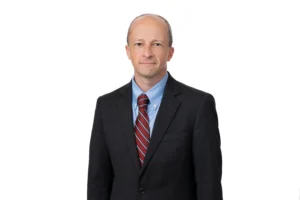
Director, Social, Cultural, and Constitutional Studies, American Enterprise Institute

Arthur J. Ennis Teaching Scholar, Villanova University

Senior Fellow, American Enterprise Institute
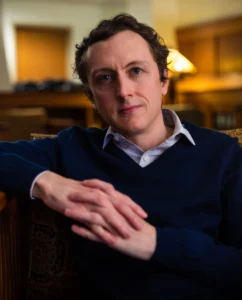
Dennis O. Doughty Collegiate Professor of Engineering, Department of Computer Science and Engineering, University of Notre Dame

Our Lady of Guadalupe Professor of Theology, University of Notre Dame
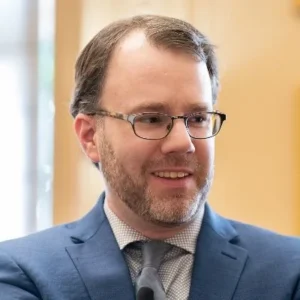
Editor, The New Atlantis
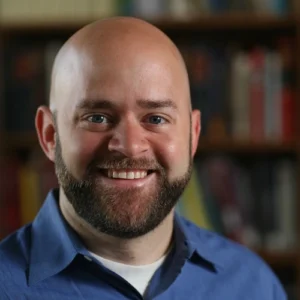
Charles E. Rice Professor of Law, University of Notre Dame
Associate Professor, Program of Liberal Studies, University of Notre Dame
The American Enterprise Institute values open dialogue, civil disagreement, and the competition of ideas as essential to a free society. AEI is independent, nonpartisan, and institutionally neutral. AEI scholars engage with academic freedom and speak for themselves.