

When he announced Australia’s National AI Plan and associated measures last month, Prime Minister Anthony Albanese promised a “world-leading” national framework that is intended to attract AI investment and impose guardrails on data centers, public‑sector use of AI, and copyright use for training foundation models. He also talked of his aspiration to make Australia a regional hub for sustainable AI infrastructure, with a government-funded industrial strategy aimed at growing a “world‑class AI ecosystem” that will produce economic opportunities through the implementation of AI applications. Much of the announcement focused on how new rules and standards will address energy and water use by the new technologies and set expectations on other factors attending environmental and community impacts.
That sounds like good 21st-century motherhood and apple pie assurances for voters. Yet Albanese’s announcement failed to identify the extent to which one industry sector has already attracted vast sums of foreign investment and uses world-leading AI and other technologies to earn billions of export-income dollars. This industry sector is not small. Mining is the largest export industry in Australia, accounting for 75 percent of the country’s exports and contributing significantly to its workforce. Mining is arguably the single largest influence on Australia’s ability to increase incomes and its standard of living since the end of World War II. And to deliver this return, it has been a world-leading innovator and user of AI-enabled technologies for at least the past 20 years. This industry has learned much from its experience that could inform the nation’s AI industry policy, so it was surprising that it did not even rate a mention in the prime ministerial announcement. The likely reason is that mining polls poorly in Australian retail politics.
Mining has always been at the forefront of industrial technological innovation. The steam engine initially pumped water out of mines long before railways began moving vast quantities of coal and ore to metal foundries (passenger transport came much later). As the Industrial Revolution has morphed into the information age, the mining industry has continued to be in the van of innovating and investing in new technologies—including AI and carbon-reduction systems. And Australia is indisputably a world leader in the industry.
Take, for example, mining railways. The Pilbara region in Western Australia is home to the world’s first—and largest—autonomous rail network (see Figure 1). Rio Tinto’s Pilbara Rail ran the first AI-enabled driverless trains in 2012. Today, its AutoHaul system transports iron ore from 18 mines to port facilities using 200 autonomous locomotives on more than 1,700 kilometers of track. Up to 53 trains run autonomously at any one time, each around 240 cars and a mile and a half long, hauling about 28,000 metric tons of ore per trip on 18-minute headways, 24 hours a day. The project was delivered by a multinational technology consortium including Australian, US, and Japanese engineering teams. The trains are managed from an operations center in suburban Perth (the state capital), which became fully operational running the AutoHaul network in 2019. At the time, it was described as “one of the world’s largest robots.”
Figure 1. Railways in Western Australia’s Pilbara Region
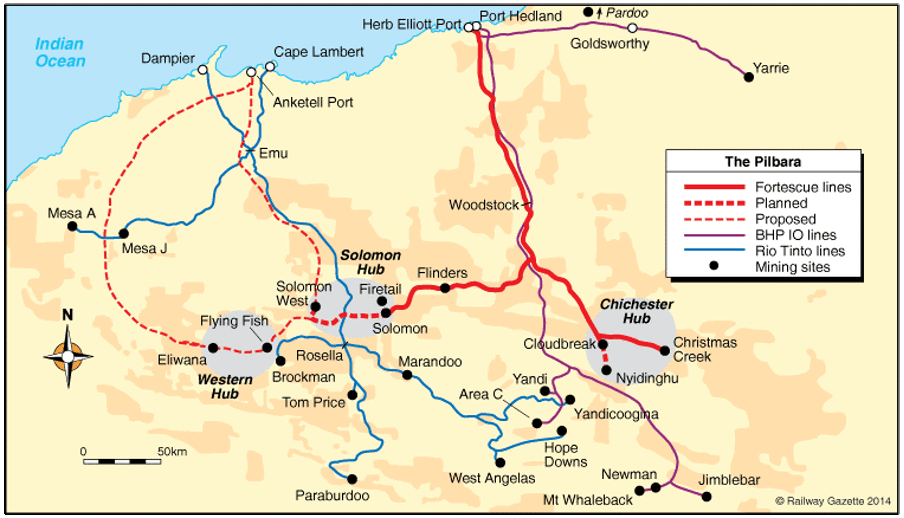
Source: Sinfit.net, “Railways in the Pilbara Region of Western Australia,” https://www.sinfin.net/railways/world/pilbara.html.
But that is not all. Rio Tinto began trials in 2008 of automated trucks programmed to drive themselves and navigate mine roads and intersections using sensors, GPS, and radar guidance systems in the same region. By 2014, 900 US-built Komatsu trucks, each equipped with over 200 sensors (including 32 in the engine) utilizing Cisco networking technology and carrying the equivalent of six fully loaded 737s, were all under control from Perth around the clock. Driverless trucks are now the norm across the entire Australian mining sector, with significant investments also by Rio Tinto’s industry fellows Fortescue and BHP.
The long-run objective is for the mining supply chain to become as automated—and as remote-controlled—as possible. Australia has been at the forefront of these developments. Rio Tinto’s Perth center also remotely controls 40 autonomous drills on five drill platforms across seven mine sites to safely and accurately drill blastholes. In addition, the center controls drones and remotely operated vehicles for real-time 3D mapping and equipment inspections and for checking slopes, crests, and walls for safety risks like cracks and signs of rock movement. Remote sensors scan and grade ores. AI-driven applications schedule production and staffing. And at the same time that mining companies have been introducing automation, they have been gradually decarbonizing boththeir fleets and other operations as well as engaging with and supporting their local communities.
Why when Prime Minister Albanese announced the AI strategy did he omit mention of mining? Perhaps because that industry needed neither government strategy nor funding to become a world AI leader, and that doesn’t suit a political agenda.