

In 1962, Michael Polanyi published “The Republic of Science” in Minerva and described a post-war vision of the scientific community as a self-governing polity: researchers pursued knowledge independent of political oversight, peer review settled disputes over knowledge claims, community accountability corrected errors—This arrangement, Polanyi argued, fostered far reaching benefits of research that flowed to the public. Critics call this vision idealized; admirers saw it as a utopian vision to strive toward.
For years “The Republic of Science” was a core reading on my graduate syllabus for my seminar on science and technology policy. Polanyi was useful for several reasons.
First, the utopian vision of science policy he describes helped to illustrate the tensions that have always been present in post-war science policy. Scientists want federal funding but little political oversight, and the public wants economic, medical, and other benefits from that investment. Polanyi argued that the institutional structure that scientists wanted was in fact the best path to delivering what the public expected. A large literature in science policy both critiques and defends this convenient expectation.
Second, regardless of where one comes out on the longstanding debates over post-War science policy—such as the Bush vs. Kilgore debate over post-war science policy1—the notion of a “republic of science” captures something real: the scientific community, in its broader societal context, functions as a republic—with its own governance of rules and norms, internal politics, and relationships with the states and publics that fund it. In the international world of science, this republic crosses national boundaries. Whether the republic ever operated as Polanyi described matters far less than whether we understand how it actually works today.
That understanding matters for science policy, a topic that has gotten lost in the context of the Trump administration’s wrecking ball approach to institutions of science. Today, I share what I learned last month at a workshop in Vienna on ongoing disruptions in science policy. The workshop was titled Disruption:Research, attended by scholars in Europe and the United States, and organized by FORWIT, TU Wien, and the University of California, Irvine.
In this post I draw on my colleagues’ presentations and our discussions without identifying anyone by name, simply as a courtesy. As you might expect, my focus is more US-centric and draws on my presentation at the meeting.2
I interpret the workshop through the lens of today’s new republic of science—and I highlight six tensions that emerged from our discussions. Today, we need more discussions of science policy writ large, and cannot focus only narrowly on the very real and consequential actions of the Trump administration—the broader context matters as the actions of the Trump administration are symptoms of larger strains.
Let’s take a look at the six tensions that I heard being discussed at the Vienna workshop.
First, the republic’s internal governance mechanisms have become procedural. Consider ethics review—these structures exist to ask hard questions about whether research causes harm. Over recent decades, ethics review has become less substantive, verifying compliance rather than scrutinizing consequences: correct forms, legal requirements, signatures. Research combining genetic data with facial recognition systems to track individuals can clear every compliance hurdle while raising ethical questions that go undiscussed. The same dynamic hollows out the open science commons: large-scale AI operations now extract value from shared knowledge without contributing back, and when technology deployment cycles shrink to months, governance structures meant for oversight of multi-year research become irrelevant.
Second, the external political conditions that once sustained the republic have eroded. Polanyi assumed states funded basic research and otherwise left the republic alone—an assumption that has always rested on political conditions. The postwar international order created not just stable conditions for science but the norms of science—ethics frameworks, data-sharing agreements, the expectation that knowledge crossed borders freely. As a 1998 congressional review of U.S. science policy observed: “The exigencies of the Cold War made science politically unassailable.” Those conditions have vanished.
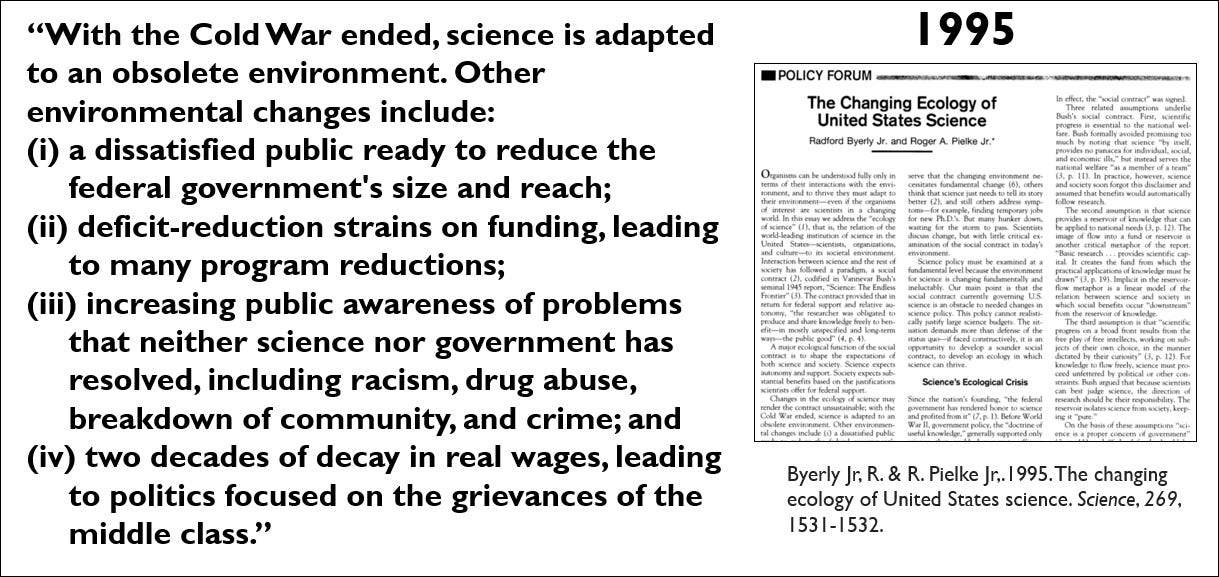
Institutions of research and development now face risks and opportunities as science policy is no longer unassailable. For example, rising geopolitical tensions have reframed science as a strategic arena, export controls function as instruments of statecraft, and some leading European scientists now conduct advanced AI and semiconductor research inside Chinese technology firms.
In the United States, the past two administrations have compounded damage from opposite directions. The Trump administration views science as oppositional to its MAGA priorities—DOGE cuts to federal research agencies, purges of scientists from advisory panels, and a proposed OMB rule redefining federal research in partisan terms all focus on the institutional base of federal research and development.
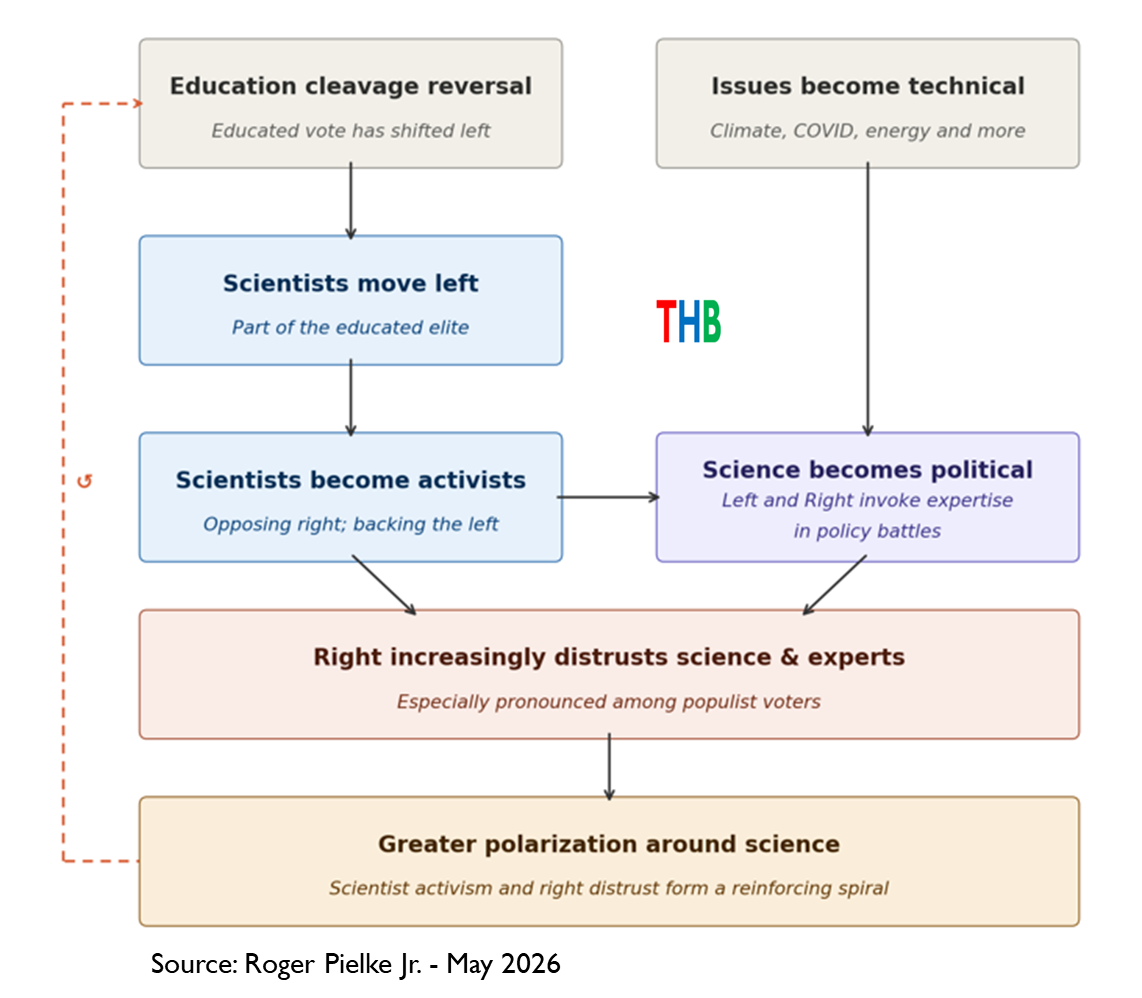
The Biden administration caused damage as well: viewing the scientific community as a partisan constituency, weaponizing scientific authority to foreclose debate, and abandoning the broad social contract in favor of tribal alignment. Many in the scientific community willingly played along with the partisan framing of science policy—supporting Democrats while opposing Republicans.
The results have played out over more than a decade, with overall confidence in science dropping and becoming much more partisan. Cleavages are not simply partisan—Confidence in scientists among Hispanic Americans dropped from 82 to 61 percent, and among Black Americans from 85 to 69 percent, between 2019 and 2023. The figure below from my talk illustrate these tensions.
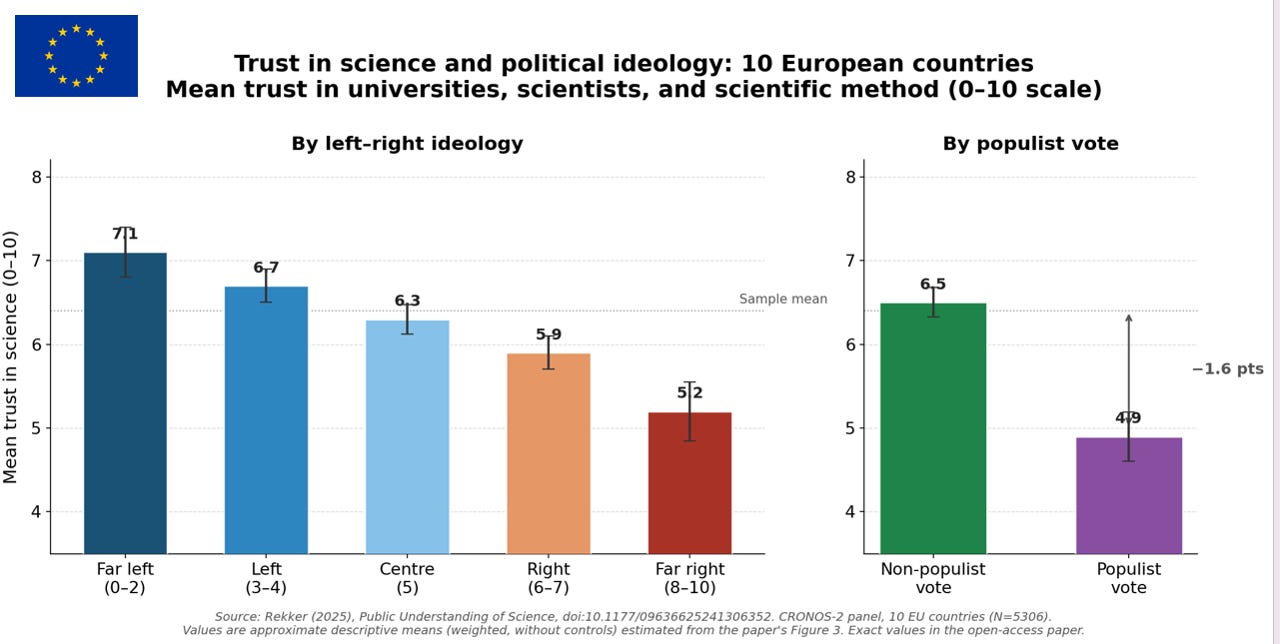
In my presentation in Vienna I shared data showing that declining confidence in science extends beyond the U.S.. The figure below shows that trust in science shows a similar ideological pattern to that seen in the U.S., with those on the left having much more trust than those to their right. Similarly, populist voters reflect less trust in science.
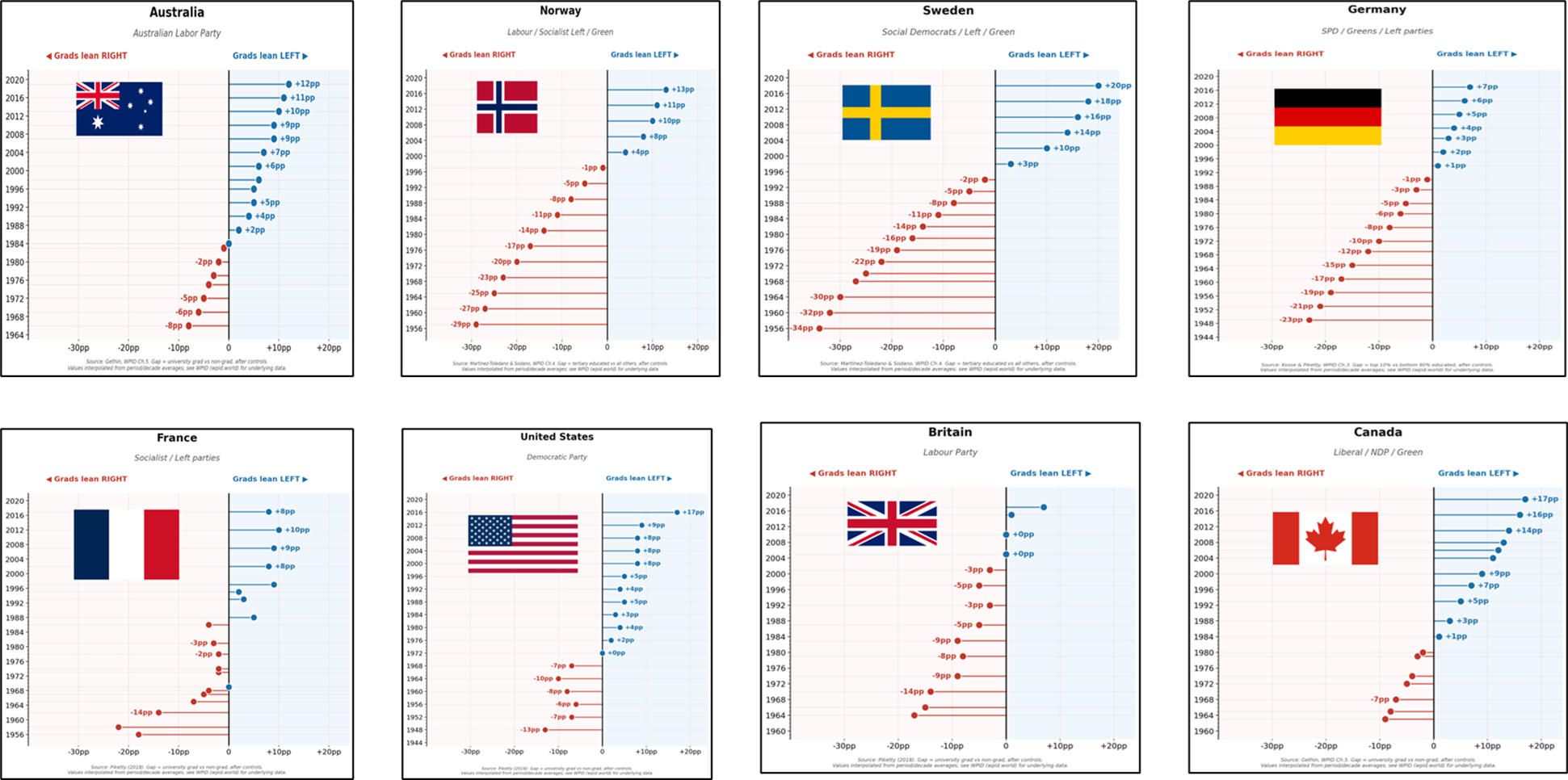
I also showed data—in the figure below, originating in the work of Gethin et al.—that shows how those with greater amounts of formal education (e.g., degrees) have increasing moved to the political left, as shown by who they vote for. The figure below has year on the y-axis (further back in time is lower) and illustrates the overall right (red) and left (blue) voting patterns over time. You can see across these eight illustrative countries that the highly educated have moved progressively to the left in each country.
In Europe, as in the U.S., university faculty self-describe themselves as being on the political left, as shown below.
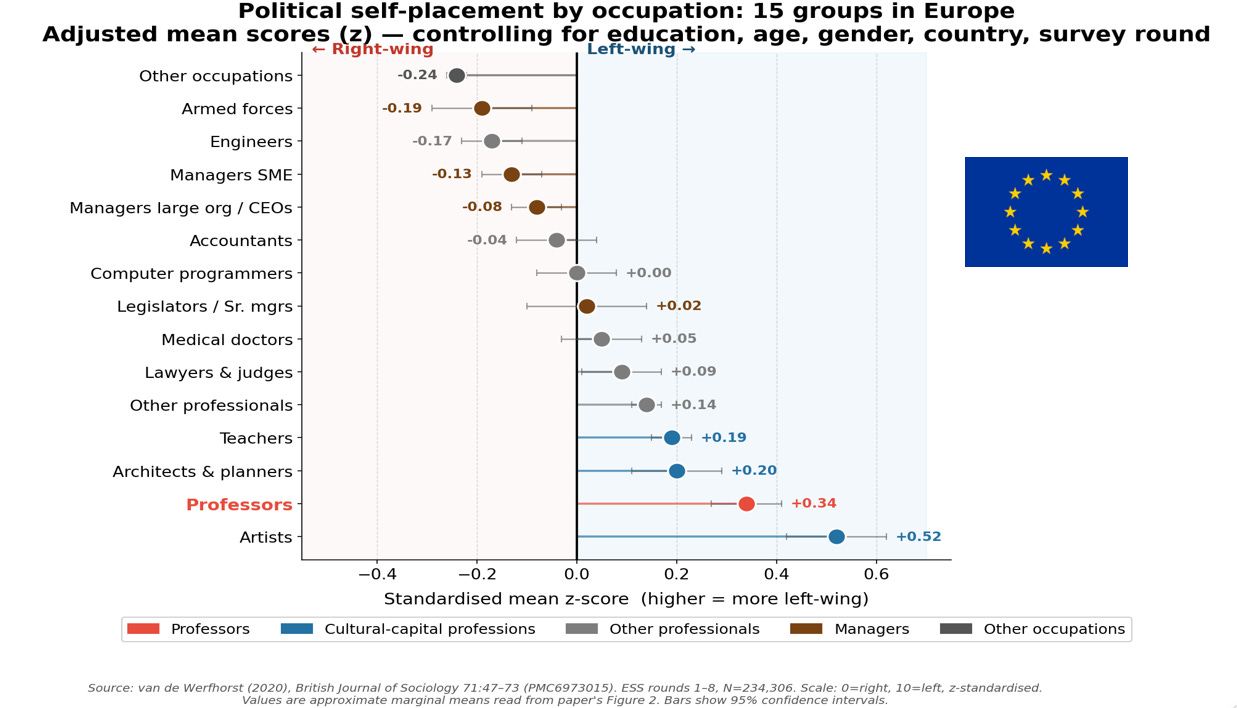
The dynamics that shape the new republic of science do not stop at national borders.
Third, society now places heavy demands on the republic. Polanyi imagined the republic generating social benefits as a byproduct of the pursuit of individual curiosity—knowledge filled a reservoir, applications flowed downhill. Today, benefits are expected to be demonstrated more clearly, and downsides addressed openly.
Contemporary society has grown considerably less patient—we see demands that research serve explicit equity goals and demonstrates value in terms that non-specialists can evaluate. COVID, climate change, and AI are each examples of contexts in which segments of the public have questioned the connections of science and technology and the real-world benefits that they observe. Not surprisingly, demands that the public “follow the science” did not help.
Fourth, the same features that generate the republic’s benefits also generate its harms. Open data accelerates discovery; it also enables combinations of datasets no participant consented to—surveillance capabilities assembled from individually innocuous pieces. Science may advance more quickly, but the public is at risk of being left behind.
The SRY gene-testing debate in elite sport offers another example: Proponents advance a single genetic marker as an objective criterion for sex-based eligibility in women’s athletic competition. But biology doesn’t support it—SRY neither reliably determines sex development nor predicts athletic performance—but framing the approach as science places it beyond political contestation. The hot politics of the gender wars makes productive discussion of the underlying science and data almost impossible, and some see this as a feature not a flaw.
In such cases, the invoking of scientific authority can work to short-circuit democratic deliberation.
Fifth, the republic faces a crisis of democratic legitimacy. The claim that the republic serves the common interest depends on maintaining enough public trust to sustain it. The rise of anti-expertise politics reflects a judgment that expert institutions serve themselves more reliably than the public. Expert institutions have failed to acknowledge limits, resisted scrutiny, and defended conclusions serving narrow rather than public interests.
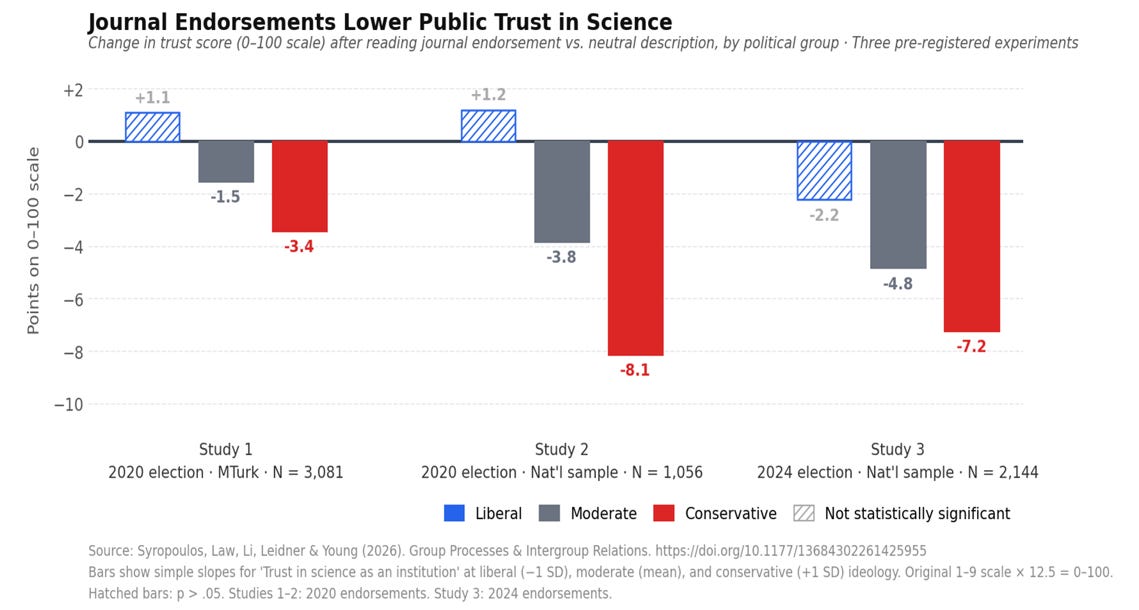
In a talk at Oslo last year, I argued that the legitimacy crisis accelerated when scientists abandoned the social contract—science serves all citizens regardless of their politics—in favor of partisan alignment. In my talk I shared data that I recently presented here at THB on how the presidential endorsement by a major science journal compromised public trust in science (shown in the figure below), and the journal endorsed even after knowing this to be the case.
The last bipartisan attempt in Congress to renegotiate the social contract came in the late 1990s. Congressman Vern Ehlers of Michigan—a Republican physicist—led the study producing Unlocking Our Future: Toward a New National Science Policy in 1998. I participated in that project.
The report called for “the involvement of citizens and organizations from across the nation” in making mid-course corrections and proposed Congress review science policy at least every five years. Neither call received a real answer: science policy muddled through leading to the crisis that we find ourselves in today. Twenty-eight years later, the conversation remains unfinished and arguably more urgent.
Sixth, organized actors demand that the republic serve something narrower than the common good. Commercial AI development operates on timescales that defeat ethical scrutiny. Contemporary AI discourse portrays humans as “powerless and flawed—in essence, outdated software in dire need of a technological fix.” This positions AI developers as providers of solutions to human deficiencies, forecloses hard questions about the technology, and narrows the space for democratic accountability.
The workshop produced agreement that the current tensions in and around science and technology—the new republic of science, as I’m calling it—should motivate an open conversation about the republic’s social contract. That conversation and short-term political action run in parallel, not in sequence.
The Trump administration’s actions are harmful. Scientific societies, universities, and individual researchers need to respond to the recent proposed OMB rule, push back on advisory panel purges, and defend the agencies that fund basic science. But as I’ve argued, how the community responds can make things better or make them worse. Understanding the broader context is key to knowing the difference.
Short-term resistance doesn’t substitute for a broader conversation about what the new republic of science might look like: Three design principles should anchor that conversation.
- First, science serves everyone regardless of who they vote for. The moment the leaders and institutions of science become a partisan constituency, we forfeit our claims of authority and legitimacy to at least half of voters.
- Second, science answers to the public democratically. Scientists make claims on public resources and public trust; democratic accountability follows from that, not as a threat to inquiry but as its legitimate grounding. Public trust will not sustain if scientists demand support while resisting scrutiny.
- Third, science and technology produce both benefits and risks, and our conversations need to reflect both. Suppressing risk assessments to win political arguments, or dismissing benefits to score points, corrodes the trust the republic depends on. The fact that most leaders in the scientific community have been silent, or even resisted, calls for a bipartisan COVID-19 origins commission offers an example of this failure.
The words of the 1998 Ehlers congressional science policy report still speak to what should come next, in 2026:
As a nation, we have much to be proud of. But we ought always to be seeking to improve. Science and technology can play important roles in driving this improvement. These beliefs—that we can do better and that improvement can come, at least in part, through a strong science and technology program—are reflected in the vision that has guided the Committee on Science in formulating this policy study and in writing this report:
The United States of America must maintain and improve its pre-eminent position in science and technology in order to advance human understanding of the universe and all it contains, and to improve the lives, health, and freedom of all peoples.
The continued health of the scientific enterprise is a central component in reaching this vision. In this report, therefore, we have laid out our recommendations for keeping the enterprise sound and strengthening it further. There is no singular, sweeping plan for doing so. The fact that keeping the enterprise healthy requires numerous actions and multiple steps is indicative of the complexity of the enterprise. The fact that we advocate not a major overhaul but rather a fine-tuning and rejuvenation is indicative of its present strength. It is also not something the Congress or even the federal government can do on its own—making these midcourse corrections will require the involvement of citizens and organizations from across the nation.