

This series takes seriously the idea of transitioning the energy economy away from fossil fuels, through the lens of the energy intensity of the U.S. economy.1
As a reminder, this series uses two different measures of energy intensity.
- Physical energy intensity refers to fuel volume or electrical generation in physical units (e.g., barrels, cubic feet, short tons, kilowatt-hours) per billion dollars of real GDP.
- Energy expenditure intensity is the real consumer (or utility) expenditure on a given energy source expressed as a percent of real GDP, a measure of the direct economic weight of energy on the economy.
Part One of this series covered four main points. Here in Part Two I continue the analysis with four additional main points, starting with Point 5. Let’s go . . .
5. For nuclear and hydro, physical energy intensity has decreased, but for solar and wind it has increased — a necessary outcome in an energy transition that relies more on these sources.
For fossil fuels, as shown in Part One, physical energy intensity has been falling since the 1970s. Nuclear and hydro physical intensities have also been falling, while wind and solar physical intensities have increased dramatically.
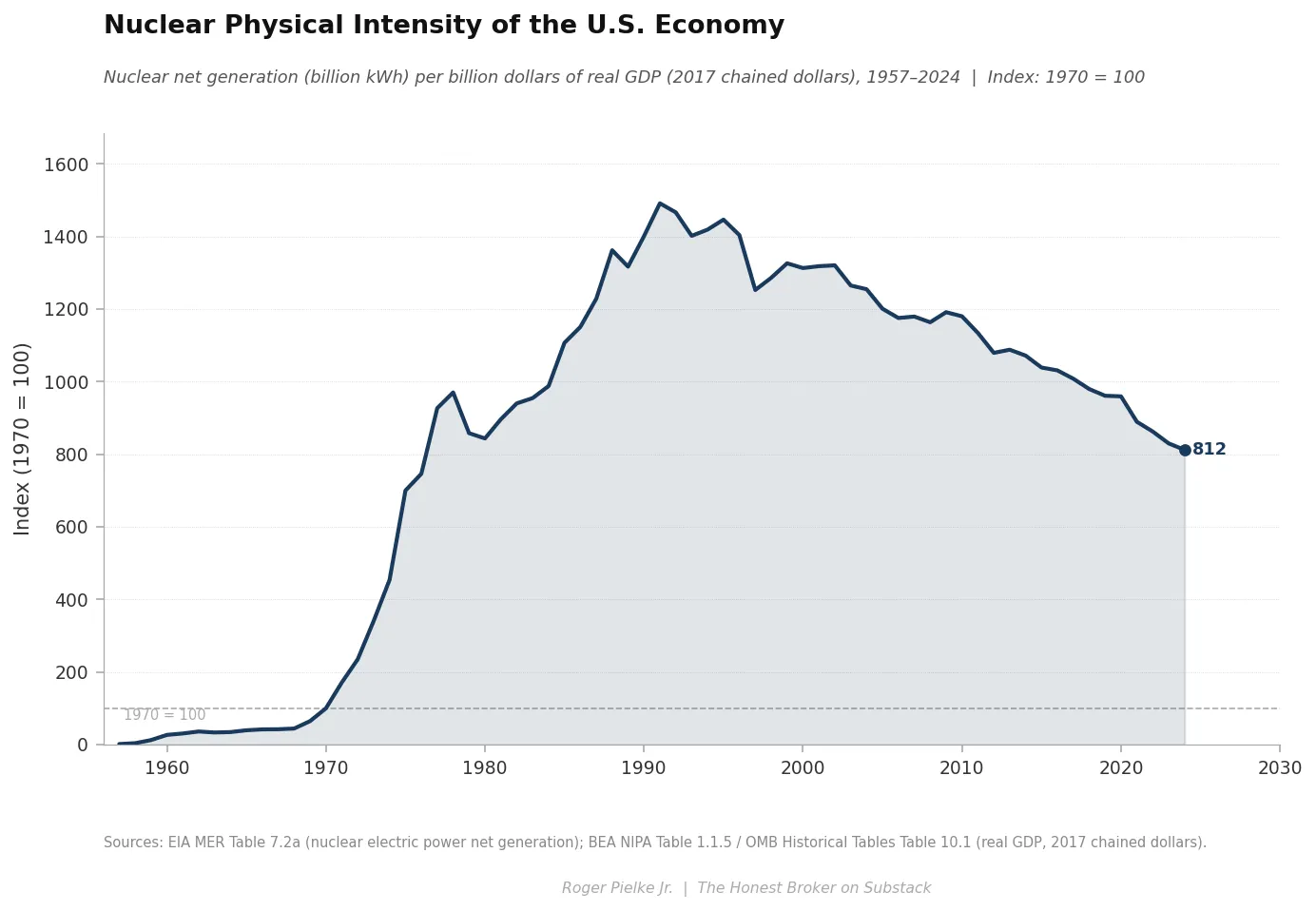
Nuclear physical intensity — kilowatt-hours per dollar of real GDP — rose about 15x from 1970 to its peak in the early 1990s as the U.S. built out its reactor fleet. It has since fallen, with no new reactors for decades, but it remains more than 8x higher relative to 1970 (1970 = 100).
Wind physical intensity has increased roughly 48x since 2000. Solar physical intensity has increased roughly 150x since 2010. Both are still rising rapidly.
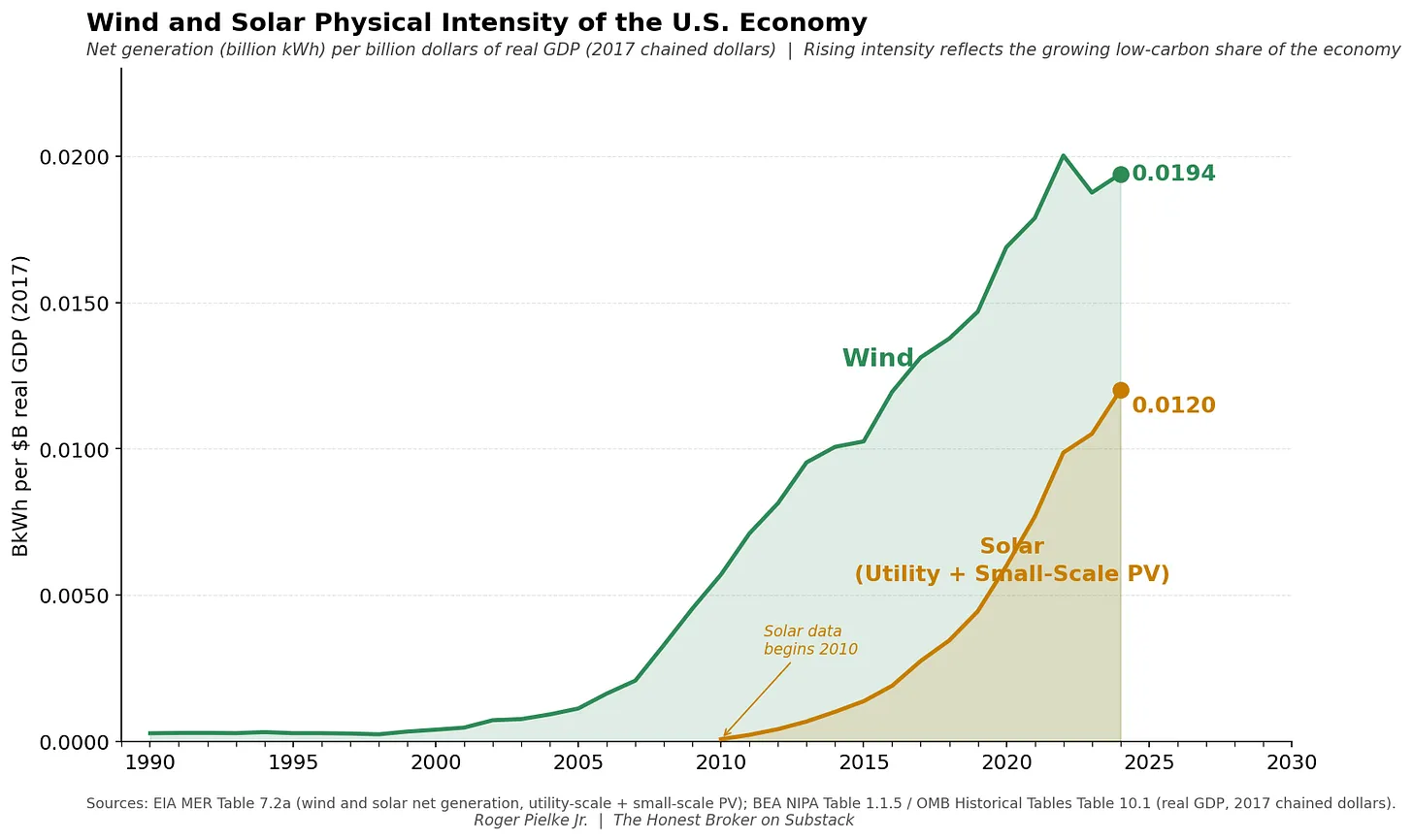
The U.S. economy generates much more electricity from wind and solar than it did a decade ago — totaling about 17% of total electricity generation in 2023.
6. Hydro physical energy intensity has declined more steeply than gasoline or natural gas.
Hydro physical intensity is down 77% since 1970. That is a steeper decline than gasoline (65%) or natural gas (64%), and approaches coal (84%).

The decline is the result of the U.S. ceasing to build large hydroelectric projects after the 1970s. The existing fleet generates a roughly fixed amount of electricity each year — with significant year-to-year volatility due to variability of precipitation — while GDP keeps growing. In 2023, hydro generated about the electricity as solar but less than wind, but its physical energy intensity is declining every year as the physical intensity of wind and solar increases dramatically.
7. In 2024, the combined energy expenditure intensity of nuclear, hydro, wind and solar was less than 0.25% of GDP.
In comparison to fossil fuels these values are quite small. In 2024:
- Nuclear generation costs = 0.14% of GDP
- Hydro: 0.019%
- Wind: 0.045%
- Solar: 0.031%
- All four combined: 0.24%
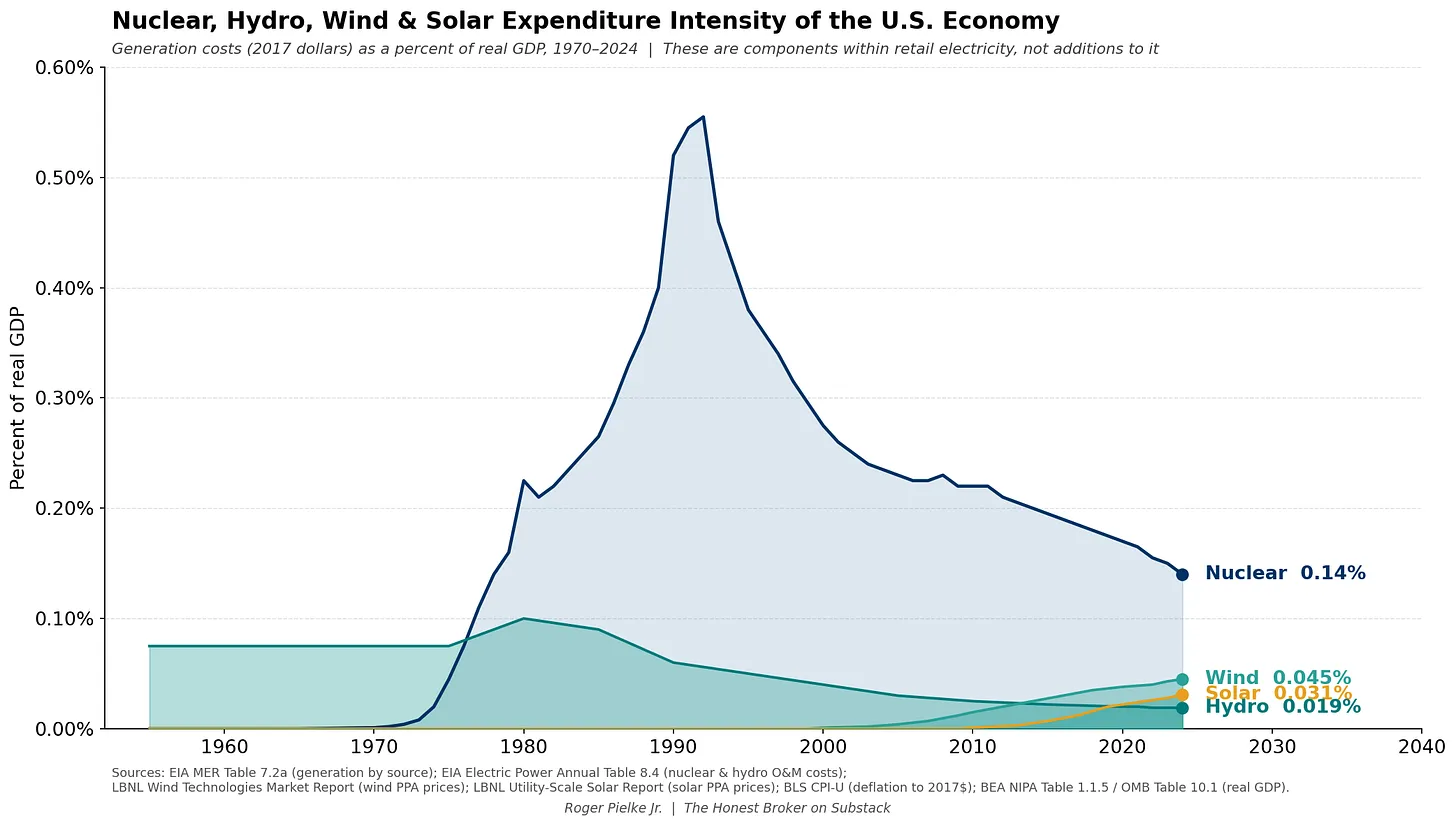
These are components within the overall retail electricity expenditure (discussed in Part 1), not additions — overall electricity intensity of the economy is ~1.9% of GDP with 0.24% the low-carbon slice.
Direct fossil-fuel-spending — gasoline, natural gas, coal — still accounts for roughly 1.9% of GDP in direct expenditure, about 8x more than all low-carbon generation sources combined.
In 2024, wind and solar expenditure intensities — ~0.045% for wind and ~0.031% for solar — are lower than nuclear (~0.14%), and their combined generation (~765 billion kWh) is a bit less than nuclear alone (~780 billion kWh), and both intensities are rising as deployment expands, while nuclear’s is falling. A deeper issue of course is intermittency: wind and solar produce power only when the wind blows and the sun shines, which means the grid needs backup capacity or storage that the contract price alone doesn’t capture. Nuclear power generates electricity around the clock, regardless of the time of day or weather.
Nuclear expenditure intensity reached 0.55% of GDP in 1991, when the U.S. fleet was fully built out and running at scale. By 2024 it had fallen to 0.14% — a 74% decline — even as nuclear’s share of electricity generation held roughly steady as the economy grew. A similar dynamic may partially apply to wind and solar as deployment matures and manufacturing costs fall, though unlike nuclear, recurring equipment replacement cycles mean that wind and solar expenditure intensities are unlikely to decline as steeply or as durably as nuclear.
A renewed commitment to nuclear power would likely push expenditure intensity upward before resuming any decline. A key uncertainty in how high that intensity figure might go is the extent to which next-generation designs such as small modular reactors can avoid the cost overruns that characterized the past U.S. nuclear build-out.
8. What does an energy transition look like in terms of energy expenditure intensity?
The economics of an energy transition are hotly debated. The energy expenditure data presented in this series provides an opportunity to look at this question differently. What does each energy source actually represent in the context of the American economy as a whole?
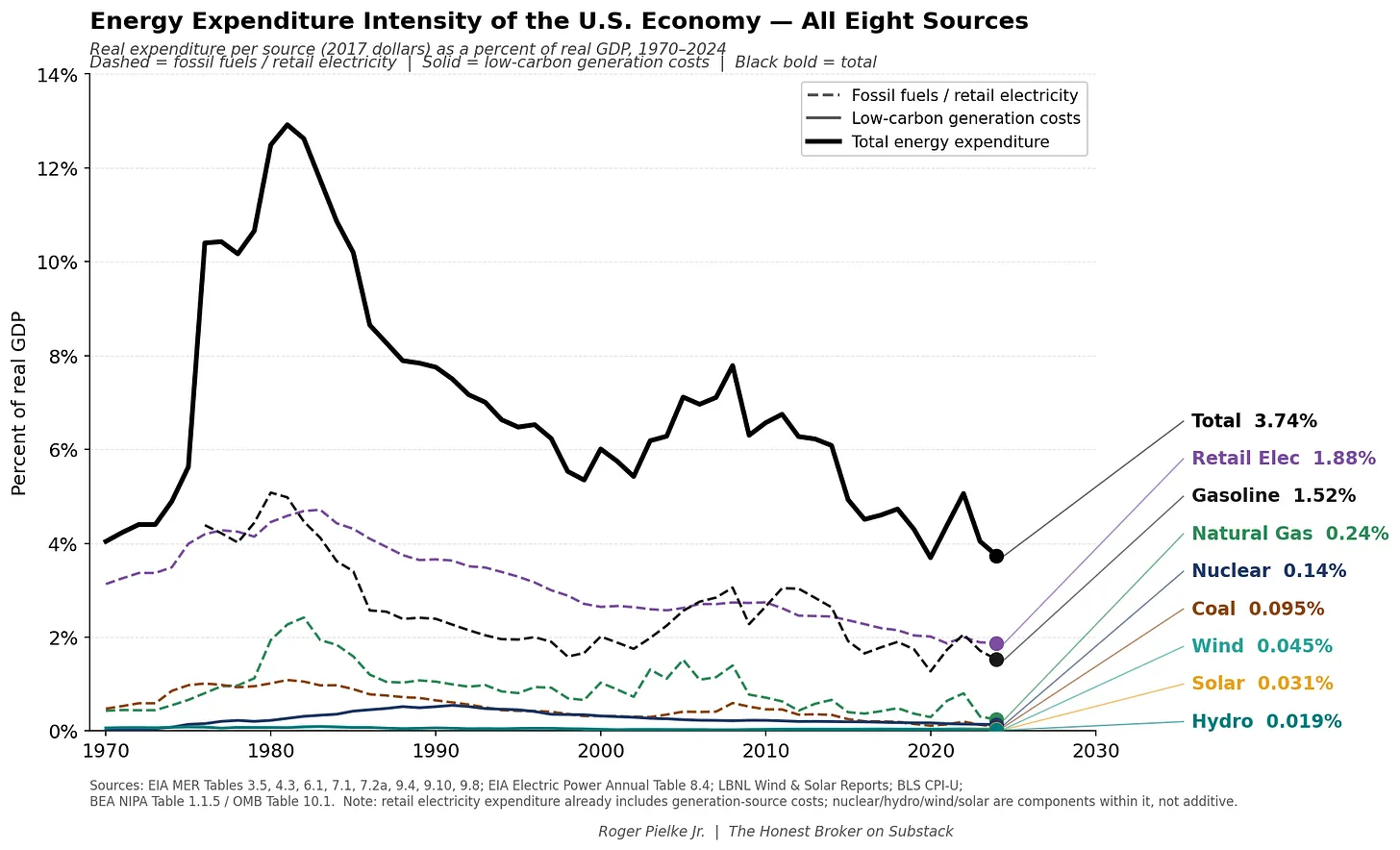
In 2024, Americans consumed 3.28 billion barrels of motor gasoline at an average price of $3.30 per gallon, amounting to 1.52% of real GDP, making gasoline the single largest direct fuel/source cost in the economy.2 For context, gasoline expenditures peaked at over 5% of GDP in 1980.
In 2026, as a result of the U.S./Israel war in Iran — something that arose well after I began the research for this series — energy expenditure costs may increase significantly in the coming weeks, months, or even years. In the coming weeks I may take a closer look at the effects of the war on energy, for now, note that in perhaps over-simplified terms, the price of a barrel of oil would need to increase to >$200 to approach a rate of expenditure consistent with the 5% of GDP of 1980.
Natural gas added another ~0.23% of GDP in 2024, and coal added ~0.09%. Together, in 2024 the energy expenditure intensity of direct fossil fuel spending was ~1.9% of GDP.
Now consider the entire low-carbon electricity portfolio: In 2024 the expenditure intensity of nuclear, hydro, wind, and solar combined totalled ~0.24% of GDP. That is roughly one eighth of direct spending on fossil fuels, while collectively powering around 40% of U.S. electricity (including nuclear at ~18%, hydro at ~6%, wind at ~10%, and solar at ~7%).
Claims that low-carbon energy is bankrupting the economy are not supported by this data.
A fair objection to the analysis thus far is that expenditure intensity, as measured here, largely leaves capital costs out of the picture. That matters, but it is also a factor we can incorporate into interpretation of the analysis.
Building a nuclear plant, constructing a wind farm, or installing a solar array requires upfront investment, often very substantial. Those capital costs are ultimately borne by ratepayers and taxpayers. The EIA’s generating cost data used here capture fuel and operations and maintenance — the ongoing costs of running existing plants — but not the original capital costs.
For almost all of the existing nuclear fleet, that is arguably appropriate: those plants were built decades ago, and sunk construction costs don’t change today’s electricity expenditures. For new wind and solar, the contract prices from LBNL’s annual market reports do implicitly bundle capital recovery into the power purchase agreement price, since developers must earn a return on their investment over the contract term.
So the comparison is somewhat asymmetric: nuclear expenditures look artificially low because they reflect an older, amortized fleet, while wind and solar expenditures reflect today’s costs of building new capacity.
Even with that caveat, expenditure intensity remains a valid and important metric for two reasons.
First, it measures what the economy is actually paying right now, which is what determines real household and business burdens — which are not represented in theoretical levelized costs calculated from modeled assumptions.
Second, the fossil fuel comparisons are largely unaffected by this limitation: gasoline, natural gas, and coal prices reflect the full market cost of extraction, refining, and delivery — capital costs included.
Fossil fuel prices — what you pay at the gas pump, on your natural gas bill, or for a ton of coal — are set largely by market forces (and to some degree, policies). A company that cannot recover the full cost of drilling a well, building a pipeline, or running a refinery will eventually go out of business. So when we measure gasoline expenditure intensity using the retail pump price, capital and operating costs are already reflected.
Fossil fuel expenditures also reflect longstanding public subsidies — such as favorable tax treatment for drilling costs and resource depletion — which means market prices likely understate the true cost of production, just as wind and solar contract prices likely understate the full capital burden when considering public subsidies.3
The broader implication for any energy transition follows directly from this: Any new capital investment in clean energy would not replace fossil fuel expenditures automatically or immediately — it would initially come on top of them.
During a buildout of the infrastructure of an energy transition, energy expenditures would result from: (a) continuing to utilize gasoline, natural gas, and coal — along with existing low-carbon energy sources; while (b) simultaneously financing the construction of the capacity intended to eventually displace fossil fuels while at the same time meeting demand for increased energy consumption.
The simple economic math of any energy transition is sobering. During the years transition investment, those costs sit on top of ongoing energy expenditures rather than replacing them. Even with continued cost reductions in costs associated with the deployment of solar and wind, the transition period would all but certainly impose a total energy burden on the economy that is substantially higher than today’s fossil baseline, at least temporarily.
To make the scale of the challenge concrete, consider a round number: if annual capital investment in an energy transition capital were to be, say, 1% of GDP — roughly $290 billion per year in current dollar terms, broadly in line with recent actual U.S. clean energy investment — then the total energy expenditure burden on the economy during the buildout would be approximately 3.1% of GDP (i.e., 1.9% + 0.21% + 1%), about 1.6x the current fossil fuel baseline or 1.5x the current total energy baseline.
That 3.1% is considerably higher than direct energy expenditures of recent decades, but also well below the >6% levels of the 1970s that were judged to be an energy crisis. A key factor in any energy transition is how complete a transition is deemed necessary and on what time scale — for instance, net zero by 2050 is vastly different from an 80% reduction in fossil fuel consumption by ~2080.
Whether the temporary burden of higher energy expenditures is judged to be worth paying depends on calculations of costs and benefits, winners and losers, and the politics of energy policy.
There is one important structural factor that could make the economics of a transition less daunting than suggested by the expenditure intensity framing: energy demand growth.
The analysis above implicitly assumes that low-carbon capacity must displace existing fossil fuel consumption. But in a growing economy that demands more energy, new low-carbon capacity can more readily claim an increasing share of incremental demand rather than having to fight for market share against already-installed fossil infrastructure.
If total electricity demand grows — driven by electrification demands of AI and computing, transportation, heating, and industrial processes — then wind, solar, and nuclear can grow rapidly in absolute terms while fossil fuel consumption holds roughly flat or declines only modestly.
The expenditure intensity of fossil fuels falls not because clean energy displaces them directly, but because the economy grows around them while new demand is met by low-carbon sources.
This is broadly what happened with coal over the past two decades: coal’s expenditure intensity fell from roughly 0.6% of GDP in 2008 to 0.1% today, not primarily because renewables directly replaced coal plants, but because electricity demand growth was met by cheaper gas and renewables while coal consumption stagnated and prices dropped.
The same dynamic could accelerate decarbonization of the overall economy if demand growth is large enough and low-carbon capacity scales fast enough to meet that demand.
Perhaps counterintuitively, rapidly increasing energy demand driven by GDP growth can facilitate an energy transition, something that directly contradicts those who argue for reducing energy demand or limiting economic growth as a route to accelerated decarbonization.
But as always, there are complexities across the energy economy.
In the electricity sector, coal plants retired not directly because of policy, but because the market made continued operation financially untenable (sometimes pushed along by policy).
The same dynamics will govern the broader retirement of fossil generation going forward: A gas plant with sunk construction costs will keep running as long as its fuel and operating costs are covered; to displace it, a wind or solar farm has to operate cheap enough to make that gas plant a money-loser. In principle, as wind and solar costs continue to fall and their share of the grid grows,4 the utilization rates of fossil plants will decline, their per-unit fixed costs will rise, and the economic case for keeping them running will erode — and policy can create conditions that influence the rate of change.
The broader the portfolio of low-carbon alternatives, the more options there will be for displacing fossil fuel generated electricity. This reality provides a compelling justification for expanding both legacy and next generation nuclear generation capacity.
Direct fuel consumption — gasoline above all — is a more difficult challenge. Displacing gasoline requires not just cheaper energy but a capital stock turnover: every internal combustion engine on the road must eventually be replaced. That turnover takes decades under any realistic scenario, and it cannot be accelerated just by making electricity cheaper — it also requires that the alternative drivetrain technology be cost-competitive at the point of vehicle purchase, that charging or fueling infrastructure exists at sufficient density, and that consumers make the switch.
This logic takes us into politically challenging directions. One of the fastest ways to displace gasoline — and the large energy expenditures that come with it — might be to open the U.S. market to foreign electric vehicles that are high quality and inexpensive. There are obviously broader economic, social, and political factors than just energy expenditures, and it is not clear (to me at least) how such a calculus might come out.
Any energy transition is really multiple transitions with different timelines, different dynamics, and different costs and benefits.5
Using expenditure intensity of GDP offers a way to measure the economic magnitude of the challenge of energy and energy transitions against a concrete, empirically grounded baseline rather than against modeled projections, heavily dependent upon assumptions.