

A group of new studies provides an emerging picture of AI use and its labor market impacts.
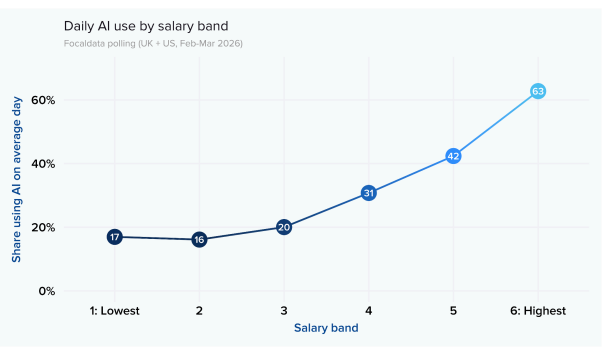
AI use tracks income and education almost perfectly.NewCensus data shows 77 percent of adults in households earning $150K or more used AI in the last two months, compared with just 42 percent of those earning under $25K. Usage by education attainment is also stark: 75 percent of bachelor’s degree holders versus 33 percent of those without a high school diploma. An FT–Focaldata poll (story / study) of US and UK workers had a similar finding, with more than 60 percent of high earners using AI daily, compared with just 16 percent of lower earners.
The benefits compound where adoption is already highest.
Among Americans who have used AI, the Census Bureau asked how it’s shaping their work and daily lives. The same income and education divides appear:
- 53 percent of those earning more than $150K say AI makes them more productive, versus 30 percent of those earning under $25K.
- 52 percent of bachelor’s degree holders feel more productive, versus 31 percent of those with only a high school diploma.
- 21 percent of bachelor’s degree holders say AI has already changed their field of work, versus just 5.1 percent of those with a high school diploma.
A new Anthropic survey of 81,000 Claude users adds a wrinkle: the largest self-reported productivity gains show up at both ends of the wage distribution: high earners are the most enthusiastic, but low-wage workers also report large gains, often from AI letting them take on tasks previously out of reach. An earlierAnthropic analysis of labor market exposure shows where the gains concentrate at the top: workers in the most AI-exposed occupations earn 47 percent more on average than those in the least-exposed ones, and graduate degree holders make up 17 percent of the most-exposed group versus just 4.5 percent of the unexposed.
The gender gap is consistent across every data source.
Census data show 62 percent of men have used AI, compared with 53 percent of women. The gap widens on confidence: 27 percent of male AI users feel prepared to use AI at work, versus just 17 percent of women. An FT analysis, citing Google’s chief economist, put women roughly 20 percent less likely to use AI overall. But training appears to close the gap quickly. Google research cited in the same piece found that a single training session tripled daily AI usage among UK women.
AI is handing incumbents a scale advantage while lowering the cost of starting something new.
A Federal Reserve FEDS Note synthesizing three federal surveys finds that the largest firms lead AI adoption. But the same note also points to earlier research showing a jump in AI-related business formation in 2023, following the launch of ChatGPT.
In other words, AI appears to be doing two things at once: handing incumbents a scale advantage, while simultaneously lowering the cost of starting something new. Anthropic’s survey picks up the same signal, with some of the largest productivity gains appearing in the management category: a group disproportionately composed of solopreneurs and founders using Claude to build their businesses.
The through-line is that AI’s benefits are currently flowing to people who already have the education, income, workplace support, and confidence to use it. Another Census paper helps explain why these gains are so uneven. Differences in productivity across firms are not just about who they employ, but how work is organized into tasks and matched with skills and technologies. AI doesn’t replace whole jobs. It improves specific tasks within them. As a result, organizations and workers already optimized around these tasks are able to capture outsized gains, while others see little impact.
This is why “AI adoption” is the wrong frame and why the productivity gap won’t close on its own. The organizations pulling ahead aren’t the ones buying more licenses; they’re the ones that have already decomposed work into tasks and matched those tasks to the right tools and people. Without that redesign, adoption becomes a tax on workflows that aren’t ready for it: more tools, same bottlenecks, widening gap.
The bigger question is what happens next. Agentic AI is arriving fast and can perform a greater range of tasks. And the skills required to manage a team of agents (clear writing, workflow design, delegation, quality oversight) are the same ones that already correlate with education and income. The question it raises is whether this leads to an economy where a small group of elite individuals and firms command swarms of agents while everyone else competes against them? Jensen Huang has already sketched what this might look like inside a single company, predicting that Nvidia’s 75,000 employees could eventually work alongside 7.5 million agents.
Or agents could finally deliver on the “AI as a team of experts” promise for people who could never afford one, unlocking a generation of hidden entrepreneurs who have an idea and the drive but lack the capital or the team to build it. Which future we get is not predetermined. It depends on the choices we make now about training, workflow redesign, and on-ramps that turn access into actual leverage.